Why is there a £17k to £19k discrepancy in allowances and expenses for councillors on Merseyside Fire and Rescue Authority?
Why is there a £17k to £19k discrepancy in allowances and expenses for councillors on Merseyside Fire and Rescue Authority?
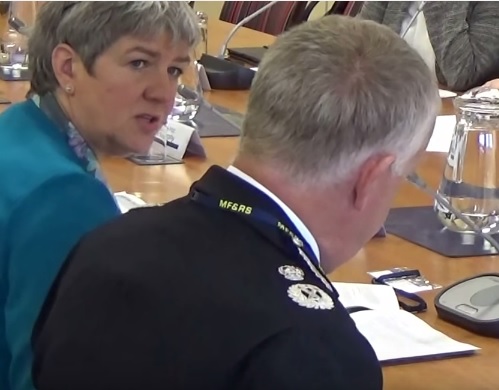
Current Chair of the Audit Sub Committee Cllr Denise Roberts is in the foreground of this photo from 27th November 2014 Background L to R former DCE Kieran Timmins DCFO Phil Garrigan and councillor
There’s a discrepancy I’ve spotted. In the papers for the Merseyside Fire and Rescue Authority Policy and Resources Committee that meets on the 17th September 2015. There is a note in the Statement of Accounts (note 29) on page 59. It’s short so I’ll quote it below as it’s mainly information in a table.
29. Members’ Allowances
The Authority comprises of 18 councillors from the 5 districts of Merseyside. The total allowances paid to members within the year were:
2014/15
2013/14
£000
£000
Allowances
225
239
Expenses
14
23
239
262
As you can see from the table above, for 2014/15 the total allowances paid to councillors is £225,000 and the total expenses for 2014/15 to councillors £14,000. The total for these two figures is £239,000.
The total allowances detailed in that table for 2014/15 are £143,242.50 + £16,140 + £24,210.00 + £1.345.00 + £8,070.00 + £11,939.57 + £6,053.04 + £2,690.33 = £213,690.44
However £213,690.44 does not equal £225,000!
The difference is £11,309.56 +-£500!
The total expenses detailed in that table are £1,338.45 + £4,175.84 + £2,194.05 = £7,708.34
Again £7,708.34 does not equal £14,000.
This difference is £6,291.66 +-£500!
The two differences add up to a grand total of £17,601.22 +-£1000.
As the figures in the statement of accounts are rounded to the nearest £1000, this could be any figure between £16,601.22 and £18,601.20.
On the expenses side I can make an educated guess that the expenses paid directly by Merseyside Fire and Rescue Authority that are detailed on the 49 pages of expenses here for councillors weren’t in June being properly coded. Page 2 of a letter from Janet Henshaw states that this amount estimated at between £5,700 and £6,700 wasn’t being coded to each councillor as it would require going through approximately 12 monthly invoices and coding expenditure to 18 councillors (which is classed as a “wholly unreasonable use of scarce resources”).
I’ve totted up amounts in the first twenty-four pages and they total £3,068.04. Assuming the other pages are for broadly similar amounts that would make the total in the ballpark figure of £6,136.08 (which is within the range of £6,291.66 +-£500).
However I’m still at a loss as to why there’s a ~£11,309.56+-£500 difference on allowances for 2014/15!
Perhaps I should ask the auditor Grant Thornton what’s going on and also raise it with the councillors and officers?
If you click on any of the buttons below, you’ll be doing me a favour by sharing this article with other people.
What connects “persons interested”, Tharmathevy Thanabalasingam and Liverpool City Council?
What connects "persons interested", Tharmathevy Thanabalasingam and Liverpool City Council?
As regular readers of this blog will know, I exercised my Audit Commission Act 1998, s.15(1) right to inspect invoices and contracts at Merseytravel (now part of the Liverpool City Region Combined Authority), Merseyside Fire and Rescue Authority, Merseyside Waste Disposal Authority (who go by the public name of Merseyside Recycling & Waste Authority) and Wirral Council for the 2014/15 financial year.
It’s well established that "persons interested" in Audit Commission Act 1998, s.15(1) means local government electors for the public body concerned.
The problem however came with my request to Liverpool City Council, as I’m not a local government elector in the Liverpool City Council area. Case law has determined that “interested person” (a term sadly not defined in the legislation itself) is a wider group than just local government electors.
R (HTV Ltd) v Bristol City Council [2004] 1 WLR 2717 is an interesting case that as far as I know isn’t available online so I looked it up in the university law library. I’ll refer to R (HTV Ltd) v Bristol City Council [2004] 1 WLR 2717 [24], [25], [39], [49] and [50] as it goes into the legislative history of who is considered an “interested person”.
"The authorities
24. The concept of “persons interested” has received very little consideration by the courts. In Marginson v Tildsley (1963) 67 JP 226 the appellant was a member of the Fleetwood urban authority for 20 years before he became bankrupt and was disqualified from the council. He sought the right to inspect the accounts under the Public Health Act 1875. He preferred an information against the clerk of the council alleging that the clerk had wrongly refused him access to the accounts. The justices dismissed the information but their decision was overturned on appeal. Lord Alvertstone CJ held that he was a person interested because although no longer a member of the council, the possibility that his estate could be liable for any surcharge rendered him a person interested.
25. In the later case of R v Bedwellty Urban District Council, Ex p Price [1934] 1 KB 333 the court held that a person interested was entitled to inspect the accounts by an agent, who in that case was his accountant. It was argued that the accountant was a person interested in his own right, but the point did not have to be determined and Avory J expressly left it open.
39. He also referred me to a passage in Jones, Local Government Audit Law, 2nd ed (1985), ch 8. The last edition of this valuable book was sadly in 1985. But in a discussion on the meaning of the concept of a “person interested”, the author expressed the view that the right was attached to any person who had a financial interest in the accounts, as well as somebody with a legal interest, such as a local government elector who has the legal right of objection.
49. I think it is somewhat artificial to say that non-domestic ratepayers do not contribute to the local authority’s budget. Although their contributions are channelled through, and will be subject to, redistribution by central government – the income will be received indirectly by the authority as a grant from central government – nevertheless I think this gives them a sufficient interest in inspecting the accounts and satisfying themselves as far as they can that they are in order. In my view, this is reinforced by the fact that they had the right for their representatives to be consulted on expenditure decisions.
50. I consider that these factors together give them a real and close interest in the council’s activities sufficient to confer these rights upon them. I would, moreover, be reluctant to think that this right, which undoubtedly existed until the Local Government Finance Act 1988, had been removed as a consequence of the restructuring of local government finances in that year. It follows that in my view the claimant is a "person interested" within the section."
So from the above I can gather that the concept of "interested person" means:
local government electors (which for Liverpool City Council at the last election I estimate at around ~320,000 local government electors)
former politicians of that public body (although as I think the ability to surcharge councillors has been repealed this may not apply in most circumstances)
those assisting local government electors such as accountants
as the R (HTV Ltd) v Bristol City Council [2004] 1 WLR 2717 case above established a company or business based in the area covered by the public body that pays business rates (or by its more formal term of non-domestic rates)
However according to Liverpool City Council my request was refused because as far as they see it, I don’t fall into one of the above categories.
I do however have a legal interest in 22 of the invoices I requested as I made a FOI request for them on the 14th May 2015. Liverpool City Council refused to supply a copy of the invoices and also refused at internal review. I exercised my right under the Freedom of Information Act 2000, s.50 to complain to the regulator (the Information Commissioner’s Office about this) on the 31st July 2015 and a decision by ICO is awaited.
Some ICO decision notices take a much wider view as to the definition of “interested person”. This decision notice (FS50582149) at part of paragraph 62 states (ACA 1998 refers to the Audit Commission Act 1998):
"As stated in paragraphs 24 and 25 above, the ACA 1998 provides a right of access to inspect accounting information for their local authority to any local government elector and ‘any persons interested’. Although the term ‘interested person’ is not defined within the ACA 1998, the Audit Commission suggest the term must refer to an individual who has a legal or financial interest in the accounts which would include local government electors, non-domestic rate payers and those with a financial or contractual relationship with the Council or those in receipt of services from the Council."
Keen followers of local government will know that the Audit Commission doesn’t exist any more, however if the Liverpool City Council shared the view of the now defunct Audit Commission that an "interested person" as was someone "in receipt of services from the Council" then I certainly fall into that category!
However, this is going off the point a little and the next point will sound like an arcane legal point. I can’t request permission from a High Court Judge for judicial review of Liverpool City Council’s decision to refuse inspection/copies of the invoices under the audit legislation that relate to the FOI request. Why is that? That’s because it would be refused due to the existing right of appeal to ICO (Information Commissioner’s Office).
I would guess that if permission for judicial review was applied for, a High Court Judge would refuse permission to the part of the request to Liverpool City Council under the audit legislation that relates to the 22 invoices that pertain to the earlier FOI request on those grounds. This is because part 5 of the Pre-Application Protocol for Judicial Review makes it clear that "Judicial review should only be used where no adequate alternative remedy, such as a right of appeal, is available."
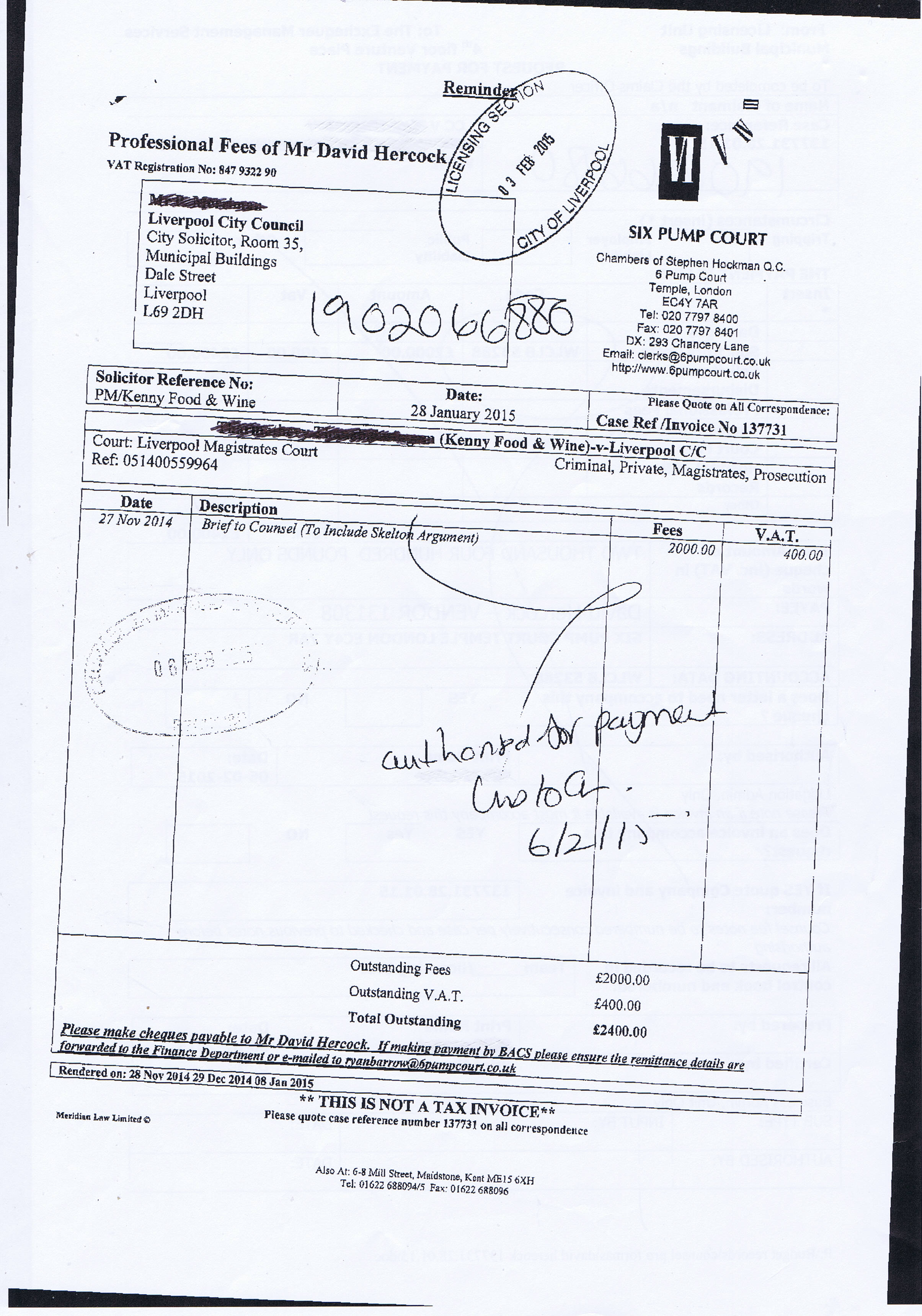
It is far better to establish the principle of whether the invoices are able to requested through FOI requests through an ICO decision notice. However before Liverpool City Council did a U-turn and realised I wasn’t a local government elector I did get copies of 7 invoices for its legal costs (the first of which is at the end of this article).
There will be a delay getting editorial approval with the other six as Liverpool City Council have done an extremely bad job at redacting some of the information. One of the invoices relates to a Family Court matter that it probably be unlawful for me to publish in its present form as the names of the parents and a child are clearly visible. Those more well versed in data protection law could perhaps leave a well-informed comment on why giving out such detail to a member of the public ain’t a good idea.
As usual the thumbnails are linked to higher resolution images for each page.
There’s a right of appeal of decisions of such committees (a Licensing and Gambling Sub-Committee is composed of councillors and meets in public) to the local magistrate court. The premises licence holder’s name is Tharmathevy Thanabalasingam (which is published in the report to that committee).
The Liverpool City Council solicitor this invoice went to is Mr. P Merriman. He’s the licensing, gaming and betting solicitor at Liverpool City Council.
Mr David Hercock of Six Pump Court is a barrister. The invoice is for £2,400 (£2000 + VAT).
Liverpool City Council invoice David Hercock Six Pump Court 28 January 2015 page 1 of 2 thumbnailLiverpool City Council invoice David Hercock Six Pump Court 28 January 2015 page 2 of 2 thumbnail
If you click on any of the buttons below, you’ll be doing me a favour by sharing this article with other people.
Police and Fire Collaboration Committee agree to joint review for collaboration between Merseyside Police & Merseyside Fire and Rescue Service
Police and Fire Collaboration Committee agree to joint review for collaboration between Merseyside Police & Merseyside Fire and Rescue Service
Merseyside Fire and Rescue Authority Police and Fire Collaboration Committee 1st September 2015 Left Jane Kennedy (Police and Crime Commissioner for Merseyside) Right Sir John Murphy (Chief Constable, Merseyside Police)
Please accept YouTube cookies to play this video. By accepting you will be accessing content from YouTube, a service provided by an external third party.
The first meeting of the Police and Fire Collaboration Committee elected Councillor Dave Hanratty as Chair.
The other members of the Police and Fire Collaboration Committee are:
Councillor Linda Maloney (Merseyside Fire and Rescue Authority) Councillor Leslie Byron (Merseyside Fire and Rescue Authority) Jane Kennedy (Police and Crime Commissioner for Merseyside) Sue Murphy (Deputy Police and Crime Commissioner for Merseyside)
The Police and Fire Collaboration Committee agreed the terms of reference.
Chief Fire Officer Dan Stephens presented the report, as did Sir Jon Murphy (Chief Constable, Merseyside Police). Chief Fire Officer Dan Stephens drew the Committee’s attention to the list of possible areas for shared services in the report at part 6. The areas detailed in the report are:
Human Resources
Occupational Health
Finance
Procurement
Vehicle Fleet Management
Estates/Facilities
Press Office
Communication and Marketing
Performance/Corporate Development
Legal Services
ICT
He gave an example of shared working in the shared estates area as the Joint Control Centre in the building where the public meeting was being held. Dan Stephens highlighted the staffing implications in the report (section 16-17 on page 10). He stated, “Just to reassure members of the Committee that a Communications Strategy is being developed to ensure that all of our staff can be fully informed. As you can appreciate there will be a fair degree of interest in the work as it progresses.” Dan Stephens also referred to the legal implications, financial implications and other implications in sections 18-24 in the report.
Chief Constable Sir John Murphy added, “Everything that the Chief has just laid out there has been drawn up in complete collaboration with ourselves”.
Jane Kennedy, Police and Crime Commissioner for Merseyside said “That’s a good and comprehensive list of potential quick gains. For knowing what I know of the potential cliff edge that the Force is facing in terms of its funding and the particular threat in particular to community policing, for me B Ways of Working is absolutely crucial to the future benefit to the community of our two services working together. I can’t, my waking nightmare is the loss of what we currently know of as community style policing.
If we lose community policing altogether then there would still be neighbourhood policing, but we are, we are very close to that now. There is potential gain from us working very closely together with your people and the Force’s people on the ground in communities which I think is probably the greatest benefit.”
Councillor Hanratty (Chair) said that they needed to have conversations with the North West Ambulance Service to see “how they could work better together with them”. He suggested inviting the Chief Executive and Chair of the Board of Trustees of the North West Ambulance Service to a future meeting. Cllr Hanratty suggested that when they got to the last agenda item adjourning the meeting.
Jane Kennedy agreed with Councillor Hanratty but that it had taken her six months to get a meeting with North West Ambulance Service but, “I completely agree with what you’re saying David”.
Cllr Hanratty referred to both Merseyside Fire and Rescue Service and Merseyside Police’s independence. He commented that both organisations do “fantastic work”.
Chief Constable Sir John Murphy said, “Just to endorse what the Commissioner’s said there, the great strength of what we’re embarking on here is the MFRS [Merseyside Fire and Rescue Service] and Merseyside Police are under the same pressures, we share the same footprint and there’s a real joint will amongst the Chief Officer Teams and the people in this room to get things done.
Our experience with working with North West Ambulance and the North West is a problem to start with is that it’s not quite that straightforward and the experience of the JCC [Joint Control Centre] here and they’re in, they’re out, they’re in, they’re out, I would not like to see North West Ambulance Service get in the way of what we’re trying to achieve, but the principle of what you’re suggesting and the commenced approach towards that I agree.”
Councillor Leslie Byrom added, “I mean I agree with everything that’s been said, what we’re going to have in the next few months of business other than the budget stuff which is going to have a real major impact on how we’re going to plan for the future. This is the first step.
We’be got the overlay also that’s emerging of the Police Reform and Criminal Justice draft Bill. That mentions fire and police collaboration. It may mean that it’s more intended to affect non-metropolitan areas, there may be a separate solution anticipated for metropolitan areas but there is so much happening I think we are going to have to be fleet of foot for the next few months, adjourning this meeting is absolutely right.
Err, enabling us to call a meeting at you know legally short notice, errm and deal with changes that are being presented to us as they happen because you know we are on a bit of a roller coaster.
NWAS [North West Ambulance Service], obviously that’s another part, that’s another facet, another side of the entire blue light issue isn’t it? And I don’t think you know, I know we have difficulty sitting round and meeting with them, but actually I think we can’t leave that as an excuse can we?
We have to, they can not participate yes, but we have to be making the, giving leadership on this issue and showing that you know there is that overlay of blue light and the cross issues. Both the money and the way that they operate are quite different to us, I understand that, but we’re all in the area of public expenditure at this time.
So you know we just try our best with NWAS [North West Ambulance Service] to move things forward.”
The Chair thanked the officers for their work and referred to it as “a culture change for both of our organisations and the way they’ve worked together so far has been tremendous as well”
The recommendations contained within the report were agreed which are:
b. Instruct the Chief Fire Officer (CFO) and Chief Constable (CC) to undertake a joint review of existing and potential opportunities for collaboration in line with the methodology detailed within the Guiding Principles.”
The Chair then agreed to adjourn the meeting, so that they could “call the meeting as and when required” but that the next meeting should be within the next couple of months.
If you click on any of the buttons below, you’ll be doing me a favour by sharing this article with other people.
Why did Wirral Council include Ian Coleman as a whistleblowing contact in the Passenger Transport Contract?
Why did Wirral Council include Ian Coleman as a whistleblowing contact in the Passenger Transport Contract?
Here is my first question to Wirral Council’s auditor (Grant Thornton) about the Passenger Transport Contract.
Wirral Council has a contract with Eye Cab Limited called the "Passenger Transport Contract". This contract started on the 1st September 2014 and runs to the 31st August 2015 and is for the provision of taxi services.
I requested to inspect a copy of the contract (see Audit Commission Act s.15(1)(a)) which was arranged for the 4th September 2015. As a local government elector for the Wirral area, I can question the auditor about the 2014/15 accounts from 9.30am on the 18th August 2015 until the accounts are closed (see Audit Commission Act 1998 s.15(2)).
Page 36 of the contract has a section titled "Section 5 CONFIDENTIAL COMPLAINTS PROCEDURE (Whistle-blowing) A Guide for Suppliers and Contractors (see attached page 36).
Passenger Transport Contract Wirral Council page 36 of 40
At the bottom of this page of the contract it details two people that a complaint under the whistleblowing procedure can be made to.
The second of these individuals is:
"Ian Coleman, Director of Finance, Wirral Borough Council, Finance Department, Treasury Building, Cleveland Street, Birkenhead, Merseyside, CH41 6BU"
Wirral Council’s Employment and Appointments Committee agreed early voluntary retirement for Ian Coleman on the 3rd October 2012 (see attached minutes).
Therefore as Ian Coleman was not an employee of Wirral Council at the time the Passenger Transport Contract was put out to tender (or when the contract was agreed) why was he included as a whistleblowing contact in the contract?
Yours sincerely,
John Brace
If you click on any of the buttons below, you’ll be doing me a favour by sharing this article with other people.
However parts 15, 18, 19 and 26 of the request were refused by Wirral Council again.
All those four parts of the request have been withheld because Wirral Council decides that section 36 (prejudice to effective conduct of public affairs) is engaged. The minutes of the Safeguarding Reference Group (part 26) have an additional reason for refusal because of section 40 (personal information).
I of course plan to appeal this latest refusal to ICO again (which probably won’t come as a surprise to anyone). Essentially however the problem I face to do with this request (which may be familiar to those who make FOI requests and have more experience than I do).
Public body decides on a reason to refuse a FOI request initially and at internal review (this stage could take up to 60 days). ICO disagree with the reason and issue a decision notice requiring the public body not to use that reason for refusing that request and to either provide the information or another reason.
So the public body comes up with another reason. That reason is challenged at internal review (again adding another 60 days). That reason is then appealed to ICO who disagree with the reason and ICO issue another decision notice.
The public body picks another reason to refuse the request and eventually it becomes a merry-go-round. The public body clearly really doesn’t want to give up the information, yet ICO is giving the public body a loophole each time a decision notice is issued by giving them a chance to pick another reason.