Cabinet to decide on 6-week consultation on closure of children’s centres
Cabinet to decide on 6-week consultation on closure of children’s centres
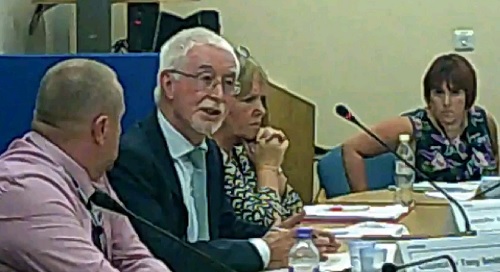
Councillor Tony Smith (Cabinet Member for Children and Family Services) at the Cabinet Meeting of 4th September 2014 L to R Cllr Stuart Whittingham, Cllr Tony Smith, Cllr Bernie Mooney and Lyndzay Roberts
Now for what I promised earlier with a story about children’s centres. Basically Cabinet is going to have to decide tonight whether or not to proceed to a six-week consultation on recommendations for the early years service and children’s centres.
The proposals which may/may not go out to consultation is to try to save £2 million. Staff at risk of losing their jobs (if a decision to go to consultation tonight) will also be consulted.
Admittedly the report has the odd type, for example at 6.1 it refers to the 2104 budget which should read the 2014 budget as Wirral Council officers don’t tend to consider the budgetary implications in ninety years time of their decisions! 😀
The proposals that may/may not go out to consultation would involve the closure of at least eight children’s centres with four being downgraded to satellite/outreach. The outright closure of some could result in a grant clawback of the money Wirral Council got to build them.
Of course if the Labour Cabinet does decide to go down this path of consultation on closure, eventually a decision will have to be made.
I’m sure at that stage or even before (if consultation is agreed tonight) the Conservatives will be reminding Labour of the election leaflets they’ve put out in recent years that told the people of Wirral that the children’s centres are not safe in Tory hands so please vote Labour. 😀
Oh dear, and what will the local newspapers make of it all?
Legal advice from Surjit Tour to 62 Wirral Council councillors on Lyndale School matter
Legal advice from Surjit Tour to 62 Wirral Council councillors on Lyndale School matter
Councillor Tony Smith (Cabinet Member for Children and Family Services) at the Special Cabinet Meeting of 4th September 2014 to discuss Lyndale School L to R Cllr Stuart Whittingham, Cllr Tony Smith (Cabinet Member for Children and Family Services), Cllr Bernie Mooney and Lyndzay Roberts
Below this is a copy of the multi page legal advice written by Surjit Tour on the 11th July 2014 and distribute to all 62 councillors present at the Council meeting on 14th July 2014 on the Lyndale School motion.
This was provided (rather surprisingly to me as it must mark a change from the past towards more openness and transparency) in response to a Freedom of Information Act request of mine made on the 14th August 2014.
In view of the Notice of Motion relating to The Lyndale School being debated at Council on 14 July 2014, I have set out below some advice for your consideration in relation to the issues of ‘Pre-determination’, ‘Pre-disposition’ and ‘Bias’ given the significance and high profile nature of this particular subject matter.
This Note is intended as guidance only and provided to help you in your consideration of these issues in the context of The Lyndale School Notice of Motion arising at Council on 14 July and thereafter.
Pre-determination and Pre-disposition
Pre-determination is defined as:
“occurring when a Member has fixed views on a matter and retains a closed mind when it comes to making a determination”.
Pre-disposition is defined as:
“a Member being open to the possibility that, however unlikely, they will hear argument during the debate about the issue that will change their mind about how they intend to vote. As long as they are willing to keep an open mind about the issue they are entitled to take part in any vote on it”.
First – the behaviour complained of has to be relevant to the issue.
Second – the situation has to be one where a notional fair-minded and well-informed observer, looking objectively at all circumstances, would consider that there is a real risk that the decision maker has refused even to consider a relevant argument or would refuse to consider a new argument.
In summary, there are no restrictions on a Member holding a provisional view on an issue (pre-disposition) but there is a problem if he/she acts with a closed mind on a subject (pre-determination).
The pre-disposition can be strong and can be publicly voiced. It might be in favour of or against a particular point. The expressing of an intention to vote in a particular way before a meeting (pre-determination) is not the same as when a Member makes it clear he/she is willing to listen to views of all sides before deciding on how to vote (pre-disposition).
Pre-disposition in decision making is fine.
Whereas, decisions made by Members later judged to have pre-determined views have been quashed by way of judicial review.
Bias
Bias is defined as:
‘a particular tendency or inclination, especially one that prevents impartial consideration of a question; prejudice’.
‘…the question is whether the fair minded and informed observer, having considered the facts would conclude that there was a real possibility that the tribunal was biased.’
It is therefore important that each Member considers his/her stance from the position of a ‘reasonable onlooker’ and decides whether there would be or could be the appearance of bias.
Only you can say whether you are biased or not.
Localism Act 2012
Section 25 of the Localism Act states that a Member should not be regarded as having a closed mind simply because he/she has previously said/or acted in a way that may have directly or indirectly indicated the view he/she may take in relation to a matter.
Section 25 does not attempt to change case law in respect of pre-determination and bias, but it has attempted to clarify it.
The section applies if there is an issue about the validity of a decision, as a result of an “allegation of bias or pre-determination”, or “otherwise” and it is relevant to that issue whether the decision maker, or any of the decision makers, had or appeared to have had a closed mind (to any extent) when making the decision. Thus it is drafted so as to catch as many cases as possible in which an allegation of pre-determination might be made which might affect the validity of a decision.
Section 25 catches allegations of actual, and apparent, pre-determination (however tenuous).
The provision is also widely phrased in another sense. It applies to views not just about the subject matter of the decision in question, but to anything a Member has done which might show, directly, or indirectly, what view he/she takes, or would take, or might take, about any matter which is relevant to the decision.
The explanatory notes to the Localism Act 2011 in relation to section 25 state that ‘Predetermination occurs where someone has a closed mind, with the effect that they are unable to apply their judgement fully and properly to an issue requiring a decision.
Section 25 is set out on pages 4 and 5 below for your reference.
5. Summary
In summary, Members are asked to consider the above advice when considering all items of Council business requiring Members to make a decision; however particularly so in relation to the Notice of Motion re: The Lyndale School.
Members are aware that no firm/final decision has been taken by the Administration in relation to The Lyndale School and therefore the Council’s Executive decision making arrangements have yet to be administered and concluded. These arrangements also include options that are still relevant to non-executive Members and accordingly you are advised to consider the implications/impact of pre-determination, pre-disposition and bias on the decision making arrangements relevant to this subject matter.
If you have any queries concerning this matter, please do not hesitate to contact me.
Kind regards
Surjit Tour
Head of Legal & Member Services
and Monitoring Officer
11 July 2014
LOCALISM ACT 2011
Section 25
(1) Subsection (2) applies if—
(a) as a result of an allegation of bias or predetermination, or otherwise, there is an issue about the validity of a decision of a relevant authority, and
(b) it is relevant to that issue whether the decision-maker, or any of the decision-makers, had or appeared to have had a closed mind (to any extent) when making the decision.
(2) A decision-maker is not to be taken to have had, or to have appeared to have had, a closed mind when making the decision just because—
(a) the decision-maker had previously done anything that directly or indirectly indicated what view the decision-maker took, or would or might take, in relation to a matter, and
(b) the matter was relevant to the decision.
(3) Subsection (2) applies in relation to a decision-maker only if that decision-maker—
(a) is a member (whether elected or not) of the relevant authority, or
(b) is a co-opted member of that authority.
(4) In this section—
“co-opted member”, in relation to a relevant authority, means a person who is not a member of the authority but who—
(a) is a member of any committee or sub-committee of the authority, or
(b) is a member of, and represents the authority on, any joint committee or joint sub-committee of the authority, and who is entitled to vote on any question which falls to be decided a any meeting of the committee or sub-committee;
“decision”, in relation to a relevant authority, means a decision made in discharging functions of the authority, functions of the authority’s executive, functions of a committee of the authority or functions of an officer of the authority (including decisions made in the discharge of any of those functions otherwise than by the person to whom the function was originally given);
“elected mayor” has the meaning given by section 9H or 39 of the Local Government Act 2000;
“member”—
(a) in relation to the Greater London Authority, means the Mayor of London or a London Assembly member, and
(b) in relation to a county council, district council, county borough council or London borough council, includes an elected mayor of the council;
“relevant authority” means—
(a) a county council,
(b) a district council,
(c) a county borough council,
(d) a London borough council,
(e) the Common Council of the City of London,
(f) the Greater London Authority,
(g) a National Park authority,
(h) the Broads Authority,
(i) the Council of the Isles of Scilly,
(j) a parish council, or
(k) a community council.
If you click on any of these buttons below, you’ll be doing me a favour by sharing this article with other people. Thanks:
Biffa asks Wirral’s Cabinet for a 10 year extension to bins & street cleaning contract worth at least £120 million
Biffa asks Wirral’s Cabinet for a 10 year extension to bins & street cleaning contract worth at least £120 million
Biffa Waste Service Limited November 2013 Invoice Wirral Council £1036840.28Biffa Waste Service Limited December 2013 Invoice Wirral Council £1032201.28Biffa Waste Service Limited January 2014 Invoice Wirral Council £1032201.28
Above are three of the recent monthly invoices to Wirral Council from Biffa Waste Services Limited for November 2013 (£1,036,840.28), December 2013 (£1,032,201.28) and January 2014 (£1,032,201.28).
I did not request the invoices for other months during that financial year (2013/14), but I would assume that the other nine are for similar amounts of around a million pounds. So why am I writing about this and what does Biffa Waste Services Limited actually do for it’s ~£12 million it receives each year from the taxpayer?
Well as shown on the invoices it’s for collecting the bins, cleaning the streets and extra amounts for working on a Bank Holiday. I’ll be looking more closely at the current contract with Biffa Waste Services Limited (which runs to 2017) tomorrow morning (if all goes well).
However there is some political news on the Biffa front, in fact Wirral Council seems to be bolstering itself for a bit of bad press coverage judging by the Cabinet papers for tonight’s Cabinet meeting (only tonight if you happen to reading this on the 11th September 2014).
I remember Mark Smith (a Wirral Council officer who is Head of Environment and Regulation) getting a grilling by the Chair (Rt Hon Frank Field MP) at a recent Birkenhead Constituency Committee meeting about what the Rt Hon Frank Field MP seemed to see as a lack of openness and transparency in the area of how Wirral Council manages the Biffa contract.
In the Rt Hon Frank Field MP’s view (from my memory of the meeting) he wanted (rather reasonably some might say) to know exactly what the public were getting for the ~£12 million a year that the taxpayer pays Biffa Waste Services Limited through Wirral Council. Sadly there was no one present at the meeting to answer for Biffa Waste Services Limited and Mark Smith seemed to struggle a little to give the kind of answers that Rt Hon Frank Field MP seemed to want to hear. However moving on from the frustrations of Birkenhead’s MP/Chair of the Birkenhead Constituency Committee to more local politics (although isn’t all politics local)?
Rather helpfully Appendix 5 to the Streetscene Environment Services Contract Extension item contains the following two entries on the risk register (copied below):
Risk No
Description of risk
Risk category
Risk Owner
Gross likelihood Score
Gross impact score
Total Gross Score
Net Likelihood Score
Net Impact Score
Total Net Score
Proposed Controls
Responsibility
Target date
RAG Status
1
District Audit scrutiny on decision process likely
Legal / Regulatory
Tara Dumas
3
4
12
3
2
6
Member decision based on thorough analysis of risks. Best value comparison work to be undertaken – Local benchmarking plus APSE/Audit commission comparison Update on market position sought from previous consultants contracted to review Biffa contract. Process to be reviewed by internal audit
TD TD TD MGa
07/07/14 completed 07/07/14 07/07/14
G C G G
2
Negative political and
media attention
Political/societal
PR team – Kathryn Green
5
3
15
3
2
6
Proactive approach by PR with press releases Confirm offer not linked to service/workforce changes
LF
Post decision 31/5/2014
G C
In other words, Wirral Council know (before any decision is formally made tonight to enter into negotiations) that it will cause all kinds of trouble. They’ve already decided (it seems) on a public relations line of telling the press it won’t lead to job losses/workforce changes and giving them the “gift” of a press release in the hope that most of the media will just print the press release more or less verbatim and not ask too many awkward questions about the matter.
They even know their external auditor (Grant Thornton) will be asking them a whole bunch of questions to do with it too but surprisingly there are even bigger risks than the media and Wirral Council’s auditors to tackle, although read the risk register at appendix 5 and hopefully you’ll see what I mean.
So how can I sum up what is proposed to be decided tonight quickly? The current contract will Biffa Waste Services Limited will end on March 2017.
The impression I get from reading between the lines of the Cabinet papers, (a lot of the detail has been kept deliberately secret by officers who are recommending to politicians to keep it secret too on grounds of commercial confidentiality) is that Biffa Waste Services Limited seemed to be somewhat concerned that if their multi-million pound 11 year contract ends on March 2017, that they would have to bid in a competitive tender against other companies and organisations for the new contract.
There’s then uncertainty (from Biffa’s perspective) over whether they would end up being the successful bidder or not. It’s called “competition” and is generally required for such large multi-million pound contracts because of all kinds of laws I won’t go into at this point and competition is therefore required for a whole bunch of good reasons.
So someone as Biffa Waste Services Limited has read through the contract they have with Wirral Council and found a caveat. There was a part in the contract that could extend it a further ten years (current prices of ~£12 million a year but yearly increases and variation are usually built-in). This contract covers “all household waste and recycling collections, street cleansing and fly tip removal, waste collection from schools and council offices and wheeled bin deliveries.”
All Biffa had to do to get a further ten years (at ~£12 million a year) was make a formal offer to Wirral Council (which they did) and have this agreed to by Wirral Council (which hasn’t happened yet with the earliest date expected being October 2014).
Due to the size of the amounts involved it has to be a decision made by politicians, specifically Wirral Council’s Cabinet and the councillor with responsibility for this area is the new(ish) Cabinet Member for Environment and Sustainability Councillor Bernie Mooney (who replaced Brian Kenny earlier this year when he lost an election in May to the Green Party councillor Pat Cleary).
However what’s in the currently exempt appendices?
Well appendix 1 covers the “value and suggested terms of the formal offer from Biffa in return for the Council extending the contract to 2027. In summary the proposal offers the Council a one-off saving split between 2014/15, 2015/16 and 2016/17 followed by a continued annual reduction in the core contract price throughout the remainder of the extended contract period to the equivalent value. Officers asked Biffa to clarify the benefits to Biffa if the contract extension was agreed.”
I’m not allowed to link to appendix 1 (as it’s currently a big secret and you’d get an “access denied” type message from Wirral Council’s website if I did), but as the language used by a Wirral Council officer is rather opaque, it has to boil down to how I imagine a summary of what Biffa offered Wirral Council … “give us a further ten years and we will give you very good price if you pick us. Our price is very reasonable, many savings to be had, very good price, you buy from us again we treat you well. We are very good supplier and will take your bins to tip and keep streets clean for another 10 years for a very reasonable price.”
Wirral Council officers asked Biffa to clarify what Biffa would get out of extending the contract a further ten years.
Biffa responded to this on the 10th February 2014. Again I’m not allowed to show you Biffa’s response either on the instructions of Wirral Council officers!
The summary of this response is again in rather opaque language “Biffa indicated that the savings they could offer arose from avoiding future procurement and mobilisation costs, the ability to re-finance their operations and a reduction in overheads due to the stable nature of the contract. The discount is not linked to any service changes.”
In other words Biffa are saying “grant us a monopoly, save us the cost of having to retender for the contract in 2017, Wirral Council will save money from having to retender the contract” (which is a bit of a debatable point really anyway considering the extra costs this will cause doing it this way) “and Biffa will be able to borrow money cheaper because we’ll have a longer contract.” To be honest I don’t agree entirely with Biffa’s point about overheads being significantly lower to justify this.
Another letter from Biffa (exempt appendix 3) is also currently being kept secret by Wirral Council officers (pending a decision by politicians). This letter is about an offer to redesign the fleet of bin lorries from 2017 to collect things such as food waste (to meet Wirral Council’s recycling targets).
However Biffa make it clear that this is absolutely Biffa’s final offer (well unless Wirral Council’s Cabinet say no to negotiations or no to the offer in October 2014 and Biffa have to bid for the new contract starting in 2017)!
Wirral Council officers seem very keen to have the Labour councillors on Wirral Council’s Cabinet agree to Biffa’s plan. “80p cheaper per a Wirral person than Liverpool” they state in the report, but strangely 15p more per a person than in Sefton!
Of course Wirral Council’s Cabinet could just choose to reject Biffa’s proposal and decide to bring the service in-house from 2017.
The recent street cleansing cuts to the contract, have been the source of both political and media attention in the recent past. However, what’s the officer’s recommendation?
Oh and before I get to that, Wirral Council asked Eunomia (are they consultants?) in 2012 to look at the Biffa contract, the consultants in fact suggested the contract should be retendered! Eunomia also suggested that if Wirral Council did agree to extend the contract by a further ten years than there should be changes to “contract clauses relating to indexation, labour cost inflation and future efficiency gains” which would be extremely sensible to do considering the current contract is linked to RPI (and let’s face it inflation is quite high)! However the Eunomia assessment is now two years out of date and things have changed somewhat since then.
As Wirral Council officers freely admit in 5.3.4 of this report, they don’t really know if this will save any money at all versus retendering the contract, it all just seems to be educated guesswork and unknown quantities.
The estimated savings have been listed, but surprisingly (and isn’t this usually the case?) not the increased costs (such as an increased audit bill from Grant Thornton for extra work).
It’s the report gets to “legal implications” that things start to get interesting!
Here’s a quote from 10.2 “The Legal colleagues have highlighted that it is necessary to limit the amount of material changes to the contract in order to minimise the risk of the Council being challenged on the legalities of the extension.”
In other words, do it right otherwise one of Biffa’s competitors, or in fact anyone could sue Wirral Council over how it was done.
Then entering into catch 22 territory the legal advice continues:
“Due consideration has been given to establishing whether the Biffa proposal offers Value for Money (Sections 4 and 5 refers) as required under the Council’s Contract Procedure Rules. However, it is important to note that the only decisive way to determine whether a more advantageous contract could be secured by the Council would be through retendering the contract.”
In other words, Wirral Council don’t know whether this saves them money without retendering the contract in 2017, but if they agree to Biffa’s proposal they won’t be retendering the contract in 2017 so they’ll never really know or be able to prove “value for money” to their external auditors Grant Thornton.
However let’s see, what do officers want? They want politicians to agree to them to enter into negotiations with Biffa, more specifically the Strategic Director of Regeneration and Environment (currently Kevin Adderley) and then report back to Cabinet no later than October 2014.
Personally (and this is just an opinion) I think politicians on the Cabinet will probably agree to enter into negotiations with Biffa tonight (even though Labour’s tendency in the past has been to bring back services in-house), if only just to keep their options open in October 2014. Quite what the Rt Hon Frank Field MP’s views on this latest development in the Biffa saga are at the time of writing unknown.
Coming up next today: What Wirral Council’s Cabinet is planning to do about Children’s Centres.
If you click on any of these buttons below, you’ll be doing me a favour by sharing this article with other people. Thanks: