Why are people objecting to the Hoylake Golf Resort plans? Regular readers of this blog will know that this blog has covered Merseyside Fire and Rescue Service’s efforts to find land for a new fire station first in the centre of Greasby and now on the outskirts of Saughall Massie. However, a much larger … Continue reading “Why are people objecting to the Hoylake Golf Resort plans?”
Why are people objecting to the Hoylake Golf Resort plans?
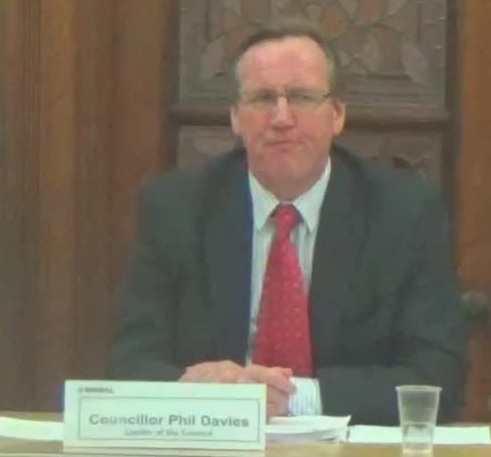
Cllr Phil Davies at a recent Cabinet meeting
Regular readers of this blog will know that this blog has covered Merseyside Fire and Rescue Service’s efforts to find land for a new fire station first in the centre of Greasby and now on the outskirts of Saughall Massie. However, a much larger threat to Wirral’s greenbelt has received little media attention so far.
The plans for a Hoylake Golf Resort cover an area of 357 acres in the greenbelt. Wirral Council own about 189 acres which they lease to farmers. Hoylake Municipal Golf Course occupies a further 106 acres (which is also owned by Wirral Council). The remaining ~63 acres are owned by private landowners. These landowners have signed agreements with Wirral Council to sell their land if planning permission is granted for the Hoylake Golf Resort.
However the Open Championship came to Wirral in 2014 and went with no announcement. Instead a year later in 2015 Wirral Council announced that the Nicklaus Joint Venture Group had been awarded preferred developer status.
Commenting on the plans for a Hoylake Golf Resort local councillor Gerry Ellis stated, “As a concept, it’s a wonderful project that could bring much employment to the area and provide excellent new facilities for residents and visitors to enjoy. However, I see many problems ahead which are likely to slow down or even derail the development. Many objectors are already raising their concerns about loss of Green Belt, disturbances to wildlife, potential flooding problems and lots of other issues.
I’m keeping an open mind on it and waiting with interest to see the planning application and other detailed proposals of the developers which are due to be revealed within the next few months.”
What were the 9 most viewed stories on this blog over the last week?
As nearly half of the stories this week are about freedom of information requests the logo above is of ICO (Information Commissioner’s Office) who are the regulator
It’s time again to look back at the 9 most viewed stories of the last week (with a few comments on each of them).
Wirral Council is forced to go back to the drawing board on plans to lease the Conway Building and Hamilton Building in Birkenhead as Isle of Man based International Centre for Technology Ltd pulls the plug on the project.
Continuing a theme running through a number of these stories about freedom of information requests, Merseyside Fire and Rescue Service’s Deputy Chief Fire Officer Phil Garrigan gives his view on freedom of information.
Is this what an “open and transparent” Council looks like?
Please accept YouTube cookies to play this video. By accepting you will be accessing content from YouTube, a service provided by an external third party.
If you accept this notice, your choice will be saved and the page will refresh.
Public Question Time 14th December 2015 where I ask a question to Councillor Adrian Jones
In his answer Cllr Adrian Jones states that Wirral Council is being “open and transparent”.
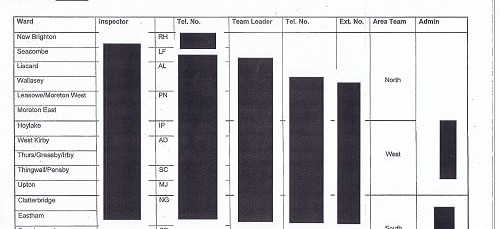
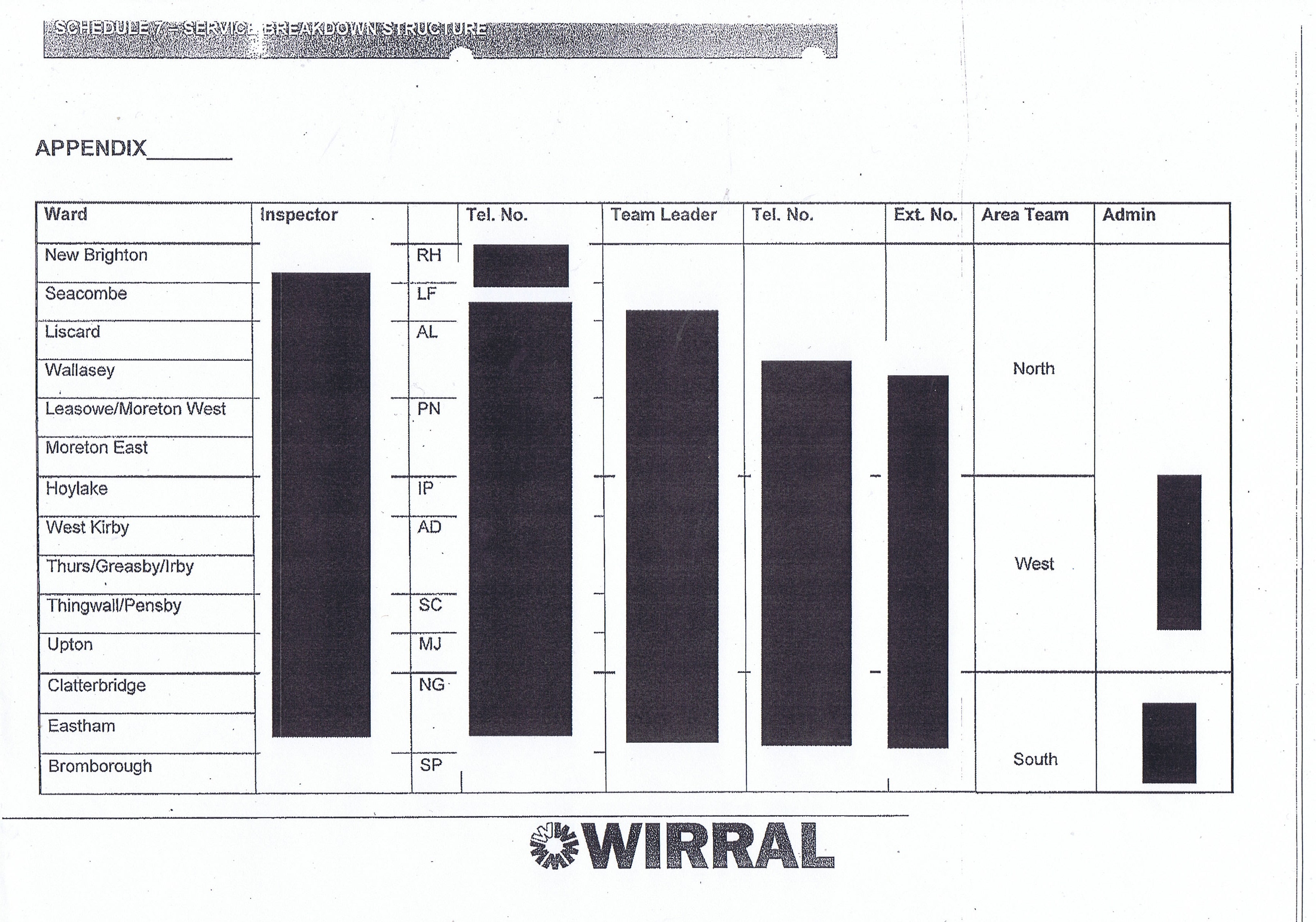
I provide below four pages from what Wirral Council supplied when I requested the Highway Services Contract that Wirral Council have with Bam Nuttall on which millions of pounds are spent each year.
These first two pages (according to the preceding page) are to do with the NRSWA Team (whatever that stands for). This team is described as “a separate team of 4 inspectors monitoring utility works and repeat defects. This team could integrate with the highway teams”
As usual the thumbnails link to higher resolution versions of the same image.
Bam Nuttall contract Service Breakdown Structure page 1 of 2 thumbnailBam Nuttall contract Service Breakdown Structure page 2 of 2 thumbnail
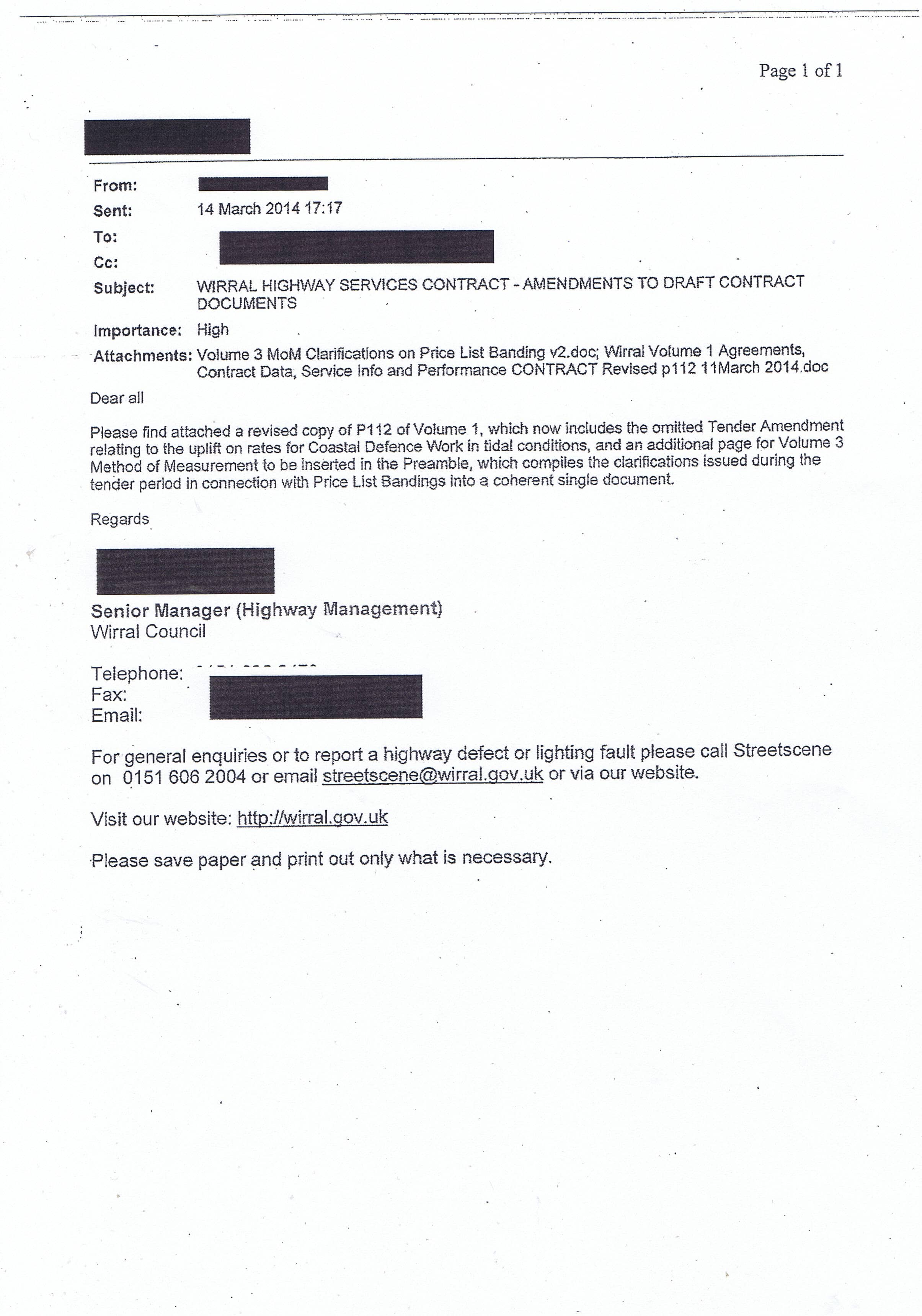
Next is an email detailing some last minutes changes to the contract. The unnamed author of this email receives this blog’s first ever Sir Humphrey Appleby award for the sentence “Please find attached a revised copy of P112 of Volume 1, which now includes the omitted Tender Amendment relating to the uplift on rates for Coastal Defence Work in tidal conditions, and an additional page for Volume 3 Method of Measurement to be inserted in the Preamble, which compiles the clarifications issued during the tender period in connection with Price List Bandings into a coherent single document.”
Bam Nuttall contract email thumbnail
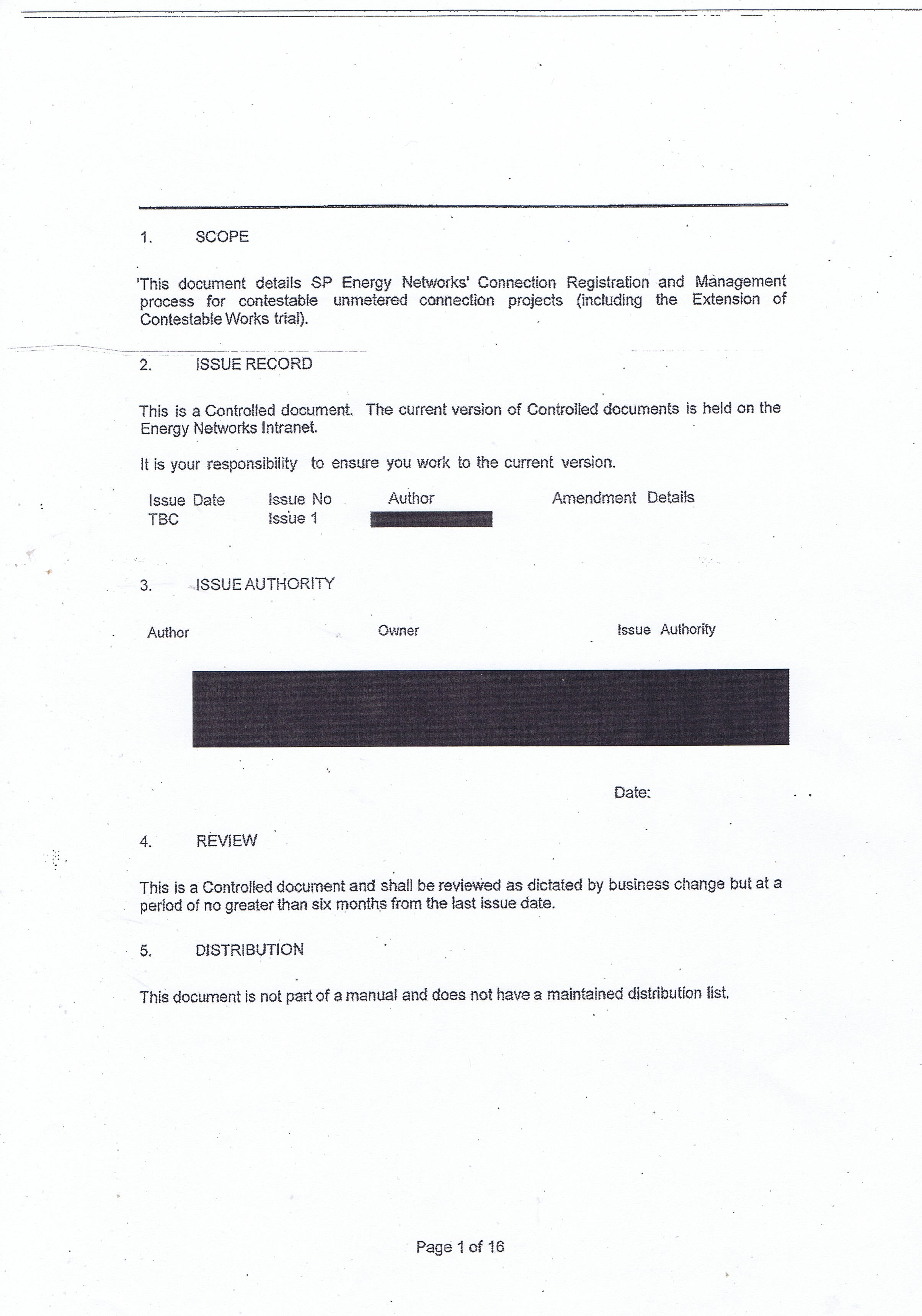
Finally, even the author of the Scottish Power Energy Network’s guide to connecting street lights to the mains electricity gets the black box treatment.
Bam Nuttall contract SP Energy Networks Connection Registration and Management thumbnail
If you click on any of these buttons below, you’ll be doing me a favour by sharing this article with other people. Thanks:
Deputy Chief Fire Officer Phil Garrigan tells councillors “90 working days” are lost each year in responding to FOI requests
Please accept YouTube cookies to play this video. By accepting you will be accessing content from YouTube, a service provided by an external third party.
If you accept this notice, your choice will be saved and the page will refresh.
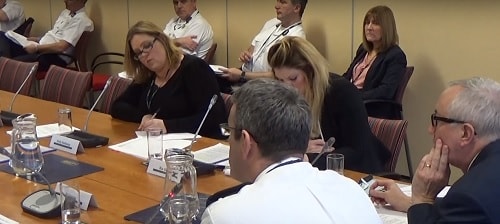
Councillors on the Performance and Scrutiny Committee (Merseyside Fire and Rescue Authority) discuss Freedom of Information requests (starts at 15m 35s) (12th January 2016)
Phil Garrigan (Deputy Chief Fire Officer) speaks about freedom of information requests to a meeting of Merseyside Fire and Rescue Authority’s Performance and Scrutiny Committee (12th January 2015)
Although I am not referred to by name (but my profession is in the report), I have made Freedom of Information requests to Merseyside Fire and Rescue Service/Merseyside Fire and Rescue Authority during the period covered by that report. An appeal of a refusal of one of those Freedom of Information requests to the Information Commissioner’s Office is referred to in the report in section 16. I am therefore declaring this as an interest at the start of this piece.
The report was introduced by Deputy Chief Fire Officer Phil Garrigan, who said “Thanks Chair, again this report relates to our response to a request from Members to better understand the implications of the Freedom of Information requests on the Authority and the report proposes to, it requests that Members review the information in relation to Freedom of Information requests and particularly the Freedom of Information Act 2000.
What I would say from the outset is that Merseyside Fire and Rescue Authority adheres to and is supportive of the Freedom of Information Act and values its role in allowing people to access information, giving them the right to find out about matters and decisions that affect them. I’d like to be absolutely crystal clear around that.
However, use of the Act is becoming increasingly popular and the volumes of freedom of information requests have increased over the recent years. The table on page 58 exemplifies that. We received, we saw freedom of information requests in 2011 at 72, 2014 at 138 and up until November 9th 2015 at 131.
So it’s clear evidence that the freedom of information requests coming through to Merseyside Fire and Rescue Authority has increased significantly over that period and you know Members will also be aware that we’ve been receiving those freedom of information requests it’s a requirement on us to turn around that information within twenty days unless we are able to provide you know a legitimate reason as to why we wouldn’t provide that information and even then we’d have to evidence that and reply to the particular individual who’s requested the information.
What we also recognise is that there are different courses of action that we could take. You know a) providing the information, redacting the information, refusing to supply the information by applying an exemption or determining that the work required to pull the information together is disproportionate and then notifying the application that it’s available by other means or by determining the request is vexatious and certainly the Information Commissioner has said you know when challenged around freedom of information and the number of requests it is always available for an authority or an organisation to reject it on the basis that it’s a vexatious request, but equally Members will appreciate the fact that that is quite challenging in that regard because it seems very protectionist, it seems as though we would be withholding information from a public member or an organisation on that basis and it’s very difficult to legitimise that in my view and more often than not the individuals, the staff who are seeking to provide that information will go way beyond what’s expected to provide that information as accurately as they are able to.
But it does place demands on our organisation, particularly as our organisation continues to reduce in size and when we look at the, our attempts to protect our front line operational response and we look at, it’s incumbent on us that we look at the support services that maintain the Service outside of our operational firefighters. So our non uniformed colleagues and uniformed colleagues are spending a significant amount of time dealing with freedom of information requests. So the organisation is shrinking but the demand around freedom of information is increasing.
So what the report does is it recognises that fact, it appreciates the fact that you know we will get a multitude of different requests in, some from you know members of the public, but some extended to journalists and so on and so forth and representative bodies who are utilising the information not in my view for how it was necessarily meant to be utilised in the first instance and also we have requests coming from organisations and companies where they are seeking to achieve you know some competitive advantage and I’m not sure again that was the basis of what the Freedom of Information Act was all about, but drawing all that in then and you know certainly it’s already been recognised as there’s been an independent Commission that has been invoked to review the Freedom of Information Act and we have provided a response to that saying that we are certainly for legitimate and less vexatious requests and maybe a levy or a charge may be applicable to kind of ensure that they are genuine and not repeated and that would maybe prevent some of the prolific you know press requirements being met when such a charge is applicable.
However the Information Commissioner has published a response in relation to that consultation which says, which argues against the introduction of fees and as I say you know starts to suggest that authorities should use section 14 which is around vexatious requests to avoid responding to the ones that were deemed to be you know vexatious in their very nature.
However you know in regards to that as I’ve previously stated, paragraph 12 describes the challenges around describing something as vexatious and that’s not something we would want to be perceived to be defensive over the policies and procedures that we’ve adopted as an Authority. I’m not sure we would want to be, or I certainly know we would want to be as transparent and open as possible but nevertheless what does that mean in reality?
In reality it means that since July 2015 through November, 32 complete requests have been responded to and the total of hours that have been attributed to that to deal with those requests 153 hours, which equates to 4.8 hours per a request for information. When you extrapolate that over the twelve month period it equates to 629 hours which again would be in effect is about 90 days of a person who is being responded to and obviously that’s a collective person because that’s an hour of one department, two hours of another, three hours of another and so on and so forth, but in totality it’s about 90 working days that’s lost from this Authority in responding to freedom of information requests at a time when we would be better focussed on our attentions on the delivery of the service and as I say protecting the front line.
However that is the kind of realities and again this is not about us, you know, challenging the utilisation of freedom of information but certainly it questions its actual usage in its broader sense and who actually uses it for what reasons.
When you then as part and parcel of our response to the consultation we asked staff members about what they felt the implications were for themselves and they are detailed in paragraph 19.
But what I would say in kind of closing and given that the kind of clarity of 90 working days lost to responding to freedom of information requests, I’ll just bring you back to the legal implications. Merseyside Fire and Rescue Authority has a duty under the Freedom of Information Act to deal with requests promptly and in the event no later than 20 working days after receipt of the requests.
Merseyside Fire and Rescue Authority can exercise its rights under the Act if an exemption has been correctly applied and in most cases the public interest test is then applied to ensure any exemptions are correctly applied under those circumstances.
So there are ways in which we can deal with them, but again just to reiterate the point, our intent is to be as open and transparent as possible. We are you know responding to each and every one and it does incur a significant cost associated with them of 90 days across the whole 12 months of the organisation irrespective of who necessarily deals with them but certainly there are members of certain teams who spend an inordinate amount of time dealing with requests. I’m happy to take any questions on that Chair.”
If you click on any of these buttons below, you’ll be doing me a favour by sharing this article with other people. Thanks:
I think it is better to provide a chronology at this stage as to how this part of the request went (references are to this part of the request).
29th March 2013 FOI request made. 29th April 2013 Internal review requested due to lack of reply. 30th April 2013 Internal review sent by Wirral Council. Request refused on cost grounds (section 12), but offer made to send minutes of Safeguarding Reference Group. 30th April 2013 Clarification over meaning of request sent/internal review as response on 30th April 2013 was first response. 30th July 2013 Internal review changes reason from cost grounds (section 12) to vexatious or repeated request (section 14). 14th August 2013 Decision appealed to Information Commissioner’s Office. 19th June 2014 Wirral Council amends reason for refusal from vexatious or repeated request (section 14) to cost grounds (section 12). 8th September 2014 ICO issue decision notice FS50509081. Decision notice overturns cost grounds (section 12) reason, finds Wirral Council failed to provide advice and assistance (section 16) and hasn’t responded to request within 20 days (section 10(1)). Wirral Council given 35 days to provide information or different reason. 4th November 2014 FOI request for minutes of Safeguarding Reference Group refused on section 40 (personal data) grounds. 12th November 2014 Internal review of 4th November 2014 decision requested. 30th April 2015 After ICO intervention Wirral Council replies. Wirral Council refuses internal review on section 14 (vexatious or repeated request) grounds. Unknown date Decision appealed to ICO. 29th July 2015 ICO issued second decision notice (FS50569254). Decision notice overturns section 14 (vexatious or repeated request) reason for all of request except adoption/fostering panel part. Finds Wirral Council have breached section 10 (again). 3rd September 2015 Wirral Council respond to decision notice FS50569254. Minutes of Safeguarding Reference Group now refused on section 36 (prejudice to effective conduct of public affairs) and section 40 (personal data). 7th September 2015 Decision appealed to Information Commissioner’s Office (ICO). 11th January 2016 Wirral Council supply minutes of Safeguarding Reference Group held on 19th April 2011.
Wouldn’t it have just been easier (as they made the offer to send the minutes of the Safeguarding Reference Group in April 2013) to supply these minutes then? How much officer time was wasted in refusing six pages of minutes on a committee that 7 councillors sat on and at least 5 senior managers (although one wasn’t present for the meeting).
Three of the 7 councillors present are no longer councillors and at least three of the senior managers have either gone into early retirement or left Wirral Council.
There are 4 parts in the six pages of minutes where names have been blacked out. Did it really take 2 years, 9 months and nearly a fortnight to do this?
What was the point in spending over 2 years and 9 months refusing this request? The minutes they’ve supplied refer to a further meeting on the 20th July 2011 so although this is welcome, they may not be the right ones! I requested the minutes of the meeting immediately before my request on the 29th March 2013. Is the implication that the incoming minority Labour administration in 2011 scrapped the Safeguarding Reference Group (which was re-established on the 15th December 2014)? I’m not sure!
If you click on any of the buttons below, you’ll be doing me a favour by sharing this article with other people.