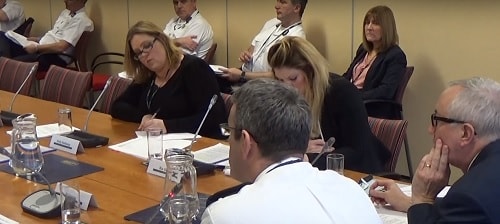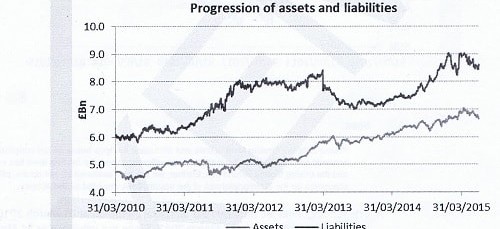
EXCLUSIVE: Leaked minutes of Merseyside Pension Fund’s Investment Monitoring Working Party held on the 17th September 2015

EXCLUSIVE: Leaked minutes of Merseyside Pension Fund’s Investment Monitoring Working Party held on the 17th September 2015                                                                      I will start off by declaring an interest as I have a close relative paid a pension by the Merseyside Pension Fund (which Wirral Council administers). My second declaration of interest is that in the section 6. … Continue reading “EXCLUSIVE: Leaked minutes of Merseyside Pension Fund’s Investment Monitoring Working Party held on the 17th September 2015”

EXCLUSIVE: Leaked minutes of Merseyside Pension Fund’s Investment Monitoring Working Party held on the 17th September 2015


I will start off by declaring an interest as I have a close relative paid a pension by the Merseyside Pension Fund (which Wirral Council administers). My second declaration of interest is that in the section 6. Notes Action Points or Discussion Points, the reason for the extraordinary meeting of the Pensions Committee held on the 28th September 2015 was to resolve my objection to the 2014/15 accounts.

These are leaked minutes as only the first page comprising a list of those present, apologies and declarations of interest was published by Wirral Council as an appendix to this report considered by the Pensions Committee at its meeting on the 16th October 2015.

The other ten pages of the minutes of the Investment Monitoring Working Party meeting the Pension Committee decided it was not in the public interest to publish.

Below are the minutes of Wirral Council’s Investment Monitoring Working Party meeting held on the 17th September 2015.


Minutes of Investment Monitoring Working Party,

17th September 2015

In attendance:


(Chair) Councillor Paul Doughty (WBC)Peter Wallach (Head of MPF)
Councillor Geoffrey Watt (WBC)Joe Blott (Strategic Director Transformation and Resources)
Councillor Cherry Povall (WBC)Leyland Otter (Senior Investment Manager)
Councillor Pat Cleary (WBC)Greg Campbell (Investment Manager)
Councillor Adrian Jones (WBC)Susannah Friar (Property Manager)
Councillor Brian Kenny (WBC)Adil Manzoor (Tax Accountant)
John Raisin (Chair of Pension Board)Noel Mills
Donna Ridland (Pension Board)Rohann Worrall (Independent Advisor)
Louise-Paul Hill (Aon Hewitt)
Emma Jones (PA to Head of Pension Fund)

Apologies were received from:

Councillor Ann McLachlan (WBC)Councillor Paulette Lappin

Declarations of Interest

Councillor Paul Doughty declared an interest due to a relation being a beneficiary of Merseyside Pension Fund.

Councillor Geoffrey Watt declared an interest due to a relation being a beneficiary of Merseyside Pension Fund.

Introduction

1. Minutes of the meetings held on 16 April 2015.

Cllr Paul Doughty (PD) opened the meeting. There were no amendments to the minutes.

Action points

None.

2. External Manager Presentations part 1

2.1 Nomura

The Nomura Portfolio Review was presented by Masaaki Tezuka (MT) the Chief Portfolio Manager (Japan) and Andrew Whitaker (AW) Head of Relations (UK). AW introduced the themes of the presentation and MT gave the performance overview and answered questions from the panel.

A discussion ensued with regard to the investment performance and the market review of the year to June 2015. The profits among Japanese manufacturers were debated and it was expressed that it is concealing the weakness in exports. MT stated that exports have been reduced but this is expected to pick up. The competitiveness against the Asian markets was quite strong due to the exchange rate of the yen. It was further discussed that the Japanese market is lagging behind the US and European market.

Action points

None.

3. External Manager Presentations part 2

3.1 JP Morgan – European Equities

Patrick Vermulean (PV), Paul Shutes (PS) and Monique Stephens presented their European equities review and reported on performance and current portfolio positioning. PV explained that Paul Shutes is replacing Nick Wilcox and will assume the responsibility for the client management of the mandate.

A discussion ensued with regard to Ryanair and their outlook for the future. It was explained that Ryanair have changed their focus toward the customer and are addressing their business and website to improve the overall service to create a better business model akin to Easyjet.

PV discussed how they endeavour to ‘take the noise out of the market’ by monitoring earnings consensus and broker analysis; looking at normal distribution to find stocks between two extremes. PV asserted that they have good contacts with management and use a consensus to take companies out of the equation. However, when companies are all moving in the same direction the signal can be weak.

Action points

None.

4. Quarterly Review

4.1 Management Executive

PJW presented the Quarterly Review which covered themes such as the collapsing values of Chinese equities, sovereign bond markets and global monetary policy. PJW asserted that Greece was the dominant theme overall.

PJW reported on a number of issues including global government bond markets and the performance of risk assets. The value of the fund and the funding position was looked at and the performance of the Fund over the quarter and over 1 and 3 years. The asset allocation and MTAA including the MTAA panel meeting on 16 June 2015 were also reported on.

A discussion ensued with regard to the formulation of the benchmark and the strategy of the asset allocation. It was stated that the benchmark is reviewed on an annual basis and the Independent Advisors also offer guidance on this process.

Action points

None.

4.2 Market Commentary

Noel Mills (NM) gave a market commentary and reported on the market background which has been affected by the decline of the global equity market post the second quarter. This is largely a result of the Chinese equity bubble bursting and the renewed possibility of a Greek default which could see a postponement of the US economy moving to higher interest rates. The volatility of the markets continues and US monetary policy is set to tighten.

Action points

None.

4.3 Aon Hewitt Update

Louis-Paul Hill (LH) presented the Strategic Monitoring Report of Aon Hewitt to members. Within his report he gave a funding level update which looked at how the estimated funding level has progressed since the 2010 valuation. The risk analysis, asset allocation, investment outlook and ideas and current research were also reported on.

An extract from that report follows below:

Funding Level Update

Introduction

The following section sets out an estimate of how the funding level has
progressed over the period from 31 March 2010 to 30 June 2015. lt also provides an attribution analysis of the changes in the funding level.

Mercer, the Fund’s actuary, has provided information regarding the Fund’s liabilities. The estimated funding level has been updated to account for the finalised valuation results from 31 March 2013.
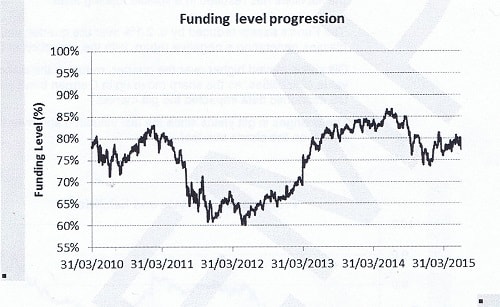
Funding Level Progression (4.2 Market Commentary)

Notes:

Please note the funding level update and attribution analysis below do not constitute actuarial advice. They are instead our best estimate of how the funding level has evolved and the driving factors behind this. Further, we are not positioned to, nor do we, offer any comments on the appropriateness of the assumptions provided by the actuary.
 
The funding level fell between the actuarial valuation at 31 March 2010 and the actuarial valuation at 31 March 2013. Since the valuation at 31 March 2013, the funding level improved over the following 12 months to 85%, however the funding level deteriorated during the second half of 2014.

Using "like for like" assumptions (based on the assumptions from 31 March 2013) the funding level at 30 June 2015 remains broadly unchanged over the quarter at 77%.


Asset and Liability progression

The chart below separates the estimated movement in the funding level from the 2010 and 2013 valuation dates into: the estimated liability value movements and the asset value movements.

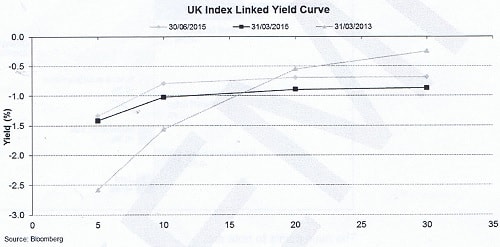
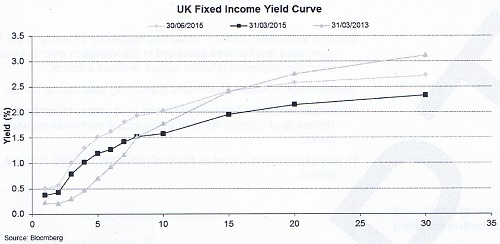
The liabilities increased in value significantly between 31 March 2011 and 31 December 2012, mainly due to falling gilt yields. For a year following the 31 March 2013 valuation, the present value of calculated liabilities reduced, when the prospect of tapering (a reduction of quantitative easing) caused gilt yields to rise. However, in the second half of 2014 this reversed, as gilt yields moved dramatically lower due to the falling oil price and uncertainty in Europe, resulting in the present value of liabilities rising above 31 March 2013 valuation levels.

While asset performance has been strong, the movement in the value of the liabilities has resulted in a volatile funding level.

The Fund’s assets reduced by c. 2.1% over the quarter, with all asset classes generating a negative return, with the exception of Property.

Gilt yields moved higher over the quarter, reducing the discounted present value of liabilities, as the sharp move up in German bond yields and mixed US economic data impacted the gilt market.

The changes in gilt yields since the last valuation and over the quarter are shown on the charts overleaf.
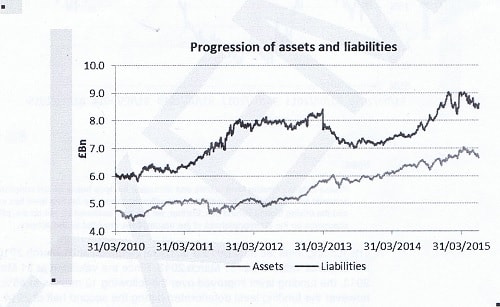
Progression of assets and liabilities
UK Fixed Income Yield Curve
UK Index Linked Yield Curve

Reasons behind the change in funding level


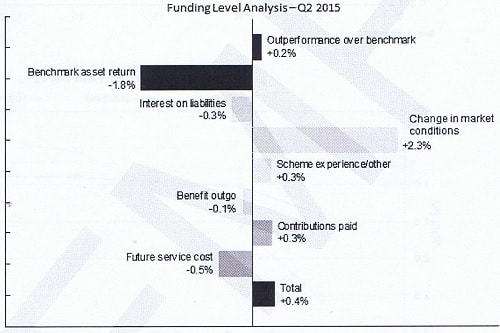
The chart overleaf decomposes the change in the funding level over the quarter across the various contributing factors. The contributing factors are:

Outperformance over benchmark — Approximate impact of any outperformance (underperformance) relative to the assets’ benchmark return.

Benchmark asset return – Approximate impact of the strategic benchmark return over period.

Interest on liabilities – Given that liabilities are due to be paid at fixed points in the future, as we move closer to the time of payment, these liabilities are discounted for one quarter less thus increasing their value (all other market conditions equal). The Fund must achieve this return to keep the funding level unchanged (everything else being equal).

Change in market conditions – Change in discount rate in this period due to changes in gilt yields and inflation expectations.

Scheme experience/other — What has happened in reality to the Fund compared to what was assumed in the valuation over the period. For example, expected inflation versus realised inflation.

Benefit outgo – Assumed benefits (pensions) paid during period.

Contributions paid – Total contributions paid (either taken from the Schedule of Contributions or using actual contributions paid) during period.

Future service cost — Cost to Fund of providing benefits accrued over period.


Funding level attribution (quarter)
Funding Level Analysis - Q2 2015
Funding Level Analysis – Q2 2015
The main points to note are:

The overall effect of the strategic benchmark asset return was a negative impact on the funding level of 1.8%.

Outperformance by managers versus their benchmarks increased the funding level by 0.2%.

Interest accrued by rolling the liabilities forward over the quarter has reduced the funding level by 0.3%.

The majority of the liabilities are real (or index linked) in nature and therefore changes in the real yield will have a large effect. The result of a continued fall in yields over the quarter is shown by a 2.3% increase in the funding level. This is called the "change in market conditions".

Contributions paid resulted in an improvement of 0.3% in the funding level. Benefit payments and future service costs reduced the funding level over the period by a further 0.1% and 0.5% respectively.

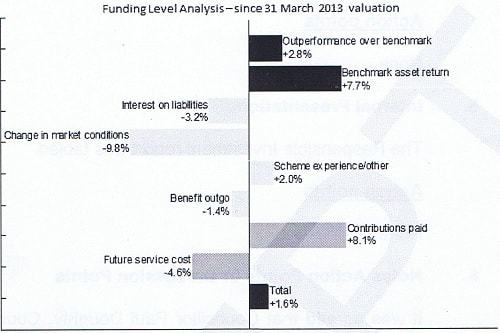
Funding level attribution (since 2013 valuation)
Funding Level Analysis - since 31 March 2013 valuation
Funding Level Analysis – since 31 March 2013 valuation
The main points to note are:

The Fund’s assets and investment managers have performed strongly since the valuation.

Interest accrued by rolling the liabilities forward has reduced the funding level although the major negative impact on funding level has come from changes in the market conditions (falling gilt yields).

Contributions paid resulted in a large improvement including the lump sum paid in Q2 2014 with benefit payments and future service costs reducing the funding level.


Action points

None.

4.4 Valuation and Performance Summary including Monitoring Report

LO reported on the monitoring reported quarter 2 and noted there were some minor differences in figures produced due to reconciliation issues.

The valuation of the fund as at 30 June 2015 stood at £6.6bn and ahead of its benchmark by 0.19% returning -2.07% against the benchmark of -2.26%. The performance of the mandates was looked at to 30 June 2015. The performance of the majority of external managers has been good but M&G Recovery and M&G EM Equity continue to lag and are being monitored by the Fund.

Amundi and Legal & General Active Fixed Income continue to be on Watch status.

Action points

None.

5. Internal Presentations

The Responsible Investment report was tabled.

Action points

None.

6. Notes Action Points or Discussion Points

It was agreed that Councillor Paul Doughty, Councillor Treena Johnson, Councillor Pat Cleary and Councillor John Fulham would make up the Task & Finish Group to review the status of ethical investments and to coordinate a public message. EJ to arrange a suitable date.

An extraordinary meeting of Pensions Committee has been arranged for the 28 September 2015 to gain approval of the Annual Report.

Action points

None.

6.1 Noting items

Task & Finish Group to meet.

Extraordinary meeting of Pensions Committee 28 September 2015.

6.2 Action points

EJ to arrange suitable date of Task & Finish Group.

6.3 Summary of Recommendations

None.

6.4 Discussion Points (including any other business)

None.

5.1 Action Points

None.

Date of Next Meeting

Thursday 8 October 2015 at 10.00 am, 6th floor, Cunard Building.

If you click on any of the buttons below, you’ll be doing me a favour by sharing this article with other people.

Why are people objecting to the Hoylake Golf Resort plans?

Why are people objecting to the Hoylake Golf Resort plans?


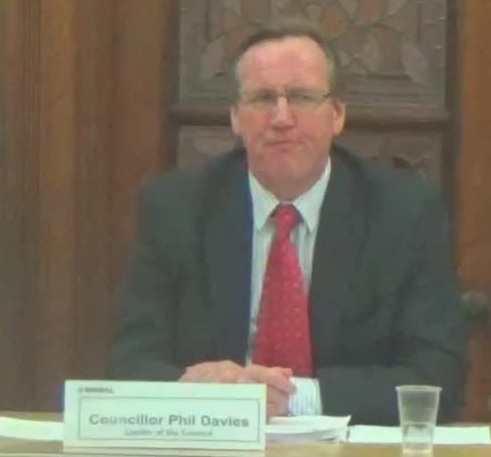
Cllr Phil Davies at a recent Cabinet meeting

Regular readers of this blog will know that this blog has covered Merseyside Fire and Rescue Service’s efforts to find land for a new fire station first in the centre of Greasby and now on the outskirts of Saughall Massie. However, a much larger threat to Wirral’s greenbelt has received little media attention so far.

The plans for a Hoylake Golf Resort cover an area of 357 acres in the greenbelt. Wirral Council own about 189 acres which they lease to farmers. Hoylake Municipal Golf Course occupies a further 106 acres (which is also owned by Wirral Council). The remaining ~63 acres are owned by private landowners. These landowners have signed agreements with Wirral Council to sell their land if planning permission is granted for the Hoylake Golf Resort.

Wirral Council’s Cabinet agreed to spend money to move forward plans for Hoylake Golf Resort back in 2013 at a cost of £178,823. In April 2014 Wirral Council’s Cabinet agreed to pay a further £113,189 so that the announcement could be made in time for the 2014 Open Championship.

However the Open Championship came to Wirral in 2014 and went with no announcement. Instead a year later in 2015 Wirral Council announced that the Nicklaus Joint Venture Group had been awarded preferred developer status.

Wirral Council ran a "consultation" that closed last month on the plans. Once a formal planning application is submitted people will have a further opportunity to state their views on the plans.

Commenting on the plans for a Hoylake Golf Resort local councillor Gerry Ellis stated, “As a concept, it’s a wonderful project that could bring much employment to the area and provide excellent new facilities for residents and visitors to enjoy. However, I see many problems ahead which are likely to slow down or even derail the development. Many objectors are already raising their concerns about loss of Green Belt, disturbances to wildlife, potential flooding problems and lots of other issues.

I’m keeping an open mind on it and waiting with interest to see the planning application and other detailed proposals of the developers which are due to be revealed within the next few months.”

Local people have set up a website to air concerns they have about the plans.

A planning application for Hoylake Golf Resort is expected towards the end of 2016.

If you click on any of the buttons below, you’ll be doing me a favour by sharing this article with other people.

What were the 9 most viewed stories on this blog over the last week?

What were the 9 most viewed stories on this blog over the last week?


ICO Information Commissioner's Office logo
As nearly half of the stories this week are about freedom of information requests the logo above is of ICO (Information Commissioner’s Office) who are the regulator

It’s time again to look back at the 9 most viewed stories of the last week (with a few comments on each of them).

1. 5 different versions of one political cover up but which one will you choose?

The BIG/ISUS issues rumble on with a government minister making sure an audit report isn’t provided in response to a FOI request.

2. Isle of Man company cancels plans for ICT College in Birkenhead

Wirral Council is forced to go back to the drawing board on plans to lease the Conway Building and Hamilton Building in Birkenhead as Isle of Man based International Centre for Technology Ltd pulls the plug on the project.

3. Incredible: FOI reveals “the Council are seeking to draw a line under matters in relation to Mr Morton”

A FOI request reveals a behind the scenes email about how to manage Martin Morton.

4. Why after 2 years, 9 months and 13 days have Wirral Council U-turned on refusing a FOI request for minutes of the Safeguarding Reference Group?

Another story about a FOI request and a long running battle to persuade Wirral Council to produce minutes of a meeting about safeguarding.

5. Does fire safety construction flaw at PFI school affect Wirral schools?

A story about how a flaw at one of Merseyside’s school built using PFI led to fire safety problems, are any of the PFI schools on Wirral affected?

6. Is this what an “open and transparent” Council looks like?

A question answered by a number of blacked out pages from the BAM Nuttall Highway Services contract.

7. Deputy Chief Fire Officer Phil Garrigan tells councillors “90 working days” are lost each year in responding to FOI requests

Continuing a theme running through a number of these stories about freedom of information requests, Merseyside Fire and Rescue Service’s Deputy Chief Fire Officer Phil Garrigan gives his view on freedom of information.

8. Cllr Foulkes on Mersey Ferries “we cherish that service and want to maintain it”

Cllr Foulkes responds to the campaign to save Woodside ferry terminal.

9. Why is Merseytravel spending £57,000 + VAT to monitor this blog?

The top story in last week’s round up details how much Merseytravel spend on media monitoring.

If you click on any of the buttons below, you’ll be doing me a favour by sharing this article with other people.

Is this what an “open and transparent” Council looks like?

Is this what an “open and transparent” Council looks like?


Please accept YouTube cookies to play this video. By accepting you will be accessing content from YouTube, a service provided by an external third party.

YouTube privacy policy

If you accept this notice, your choice will be saved and the page will refresh.

Public Question Time 14th December 2015 where I ask a question to Councillor Adrian Jones

In his answer Cllr Adrian Jones states that Wirral Council is being “open and transparent”.

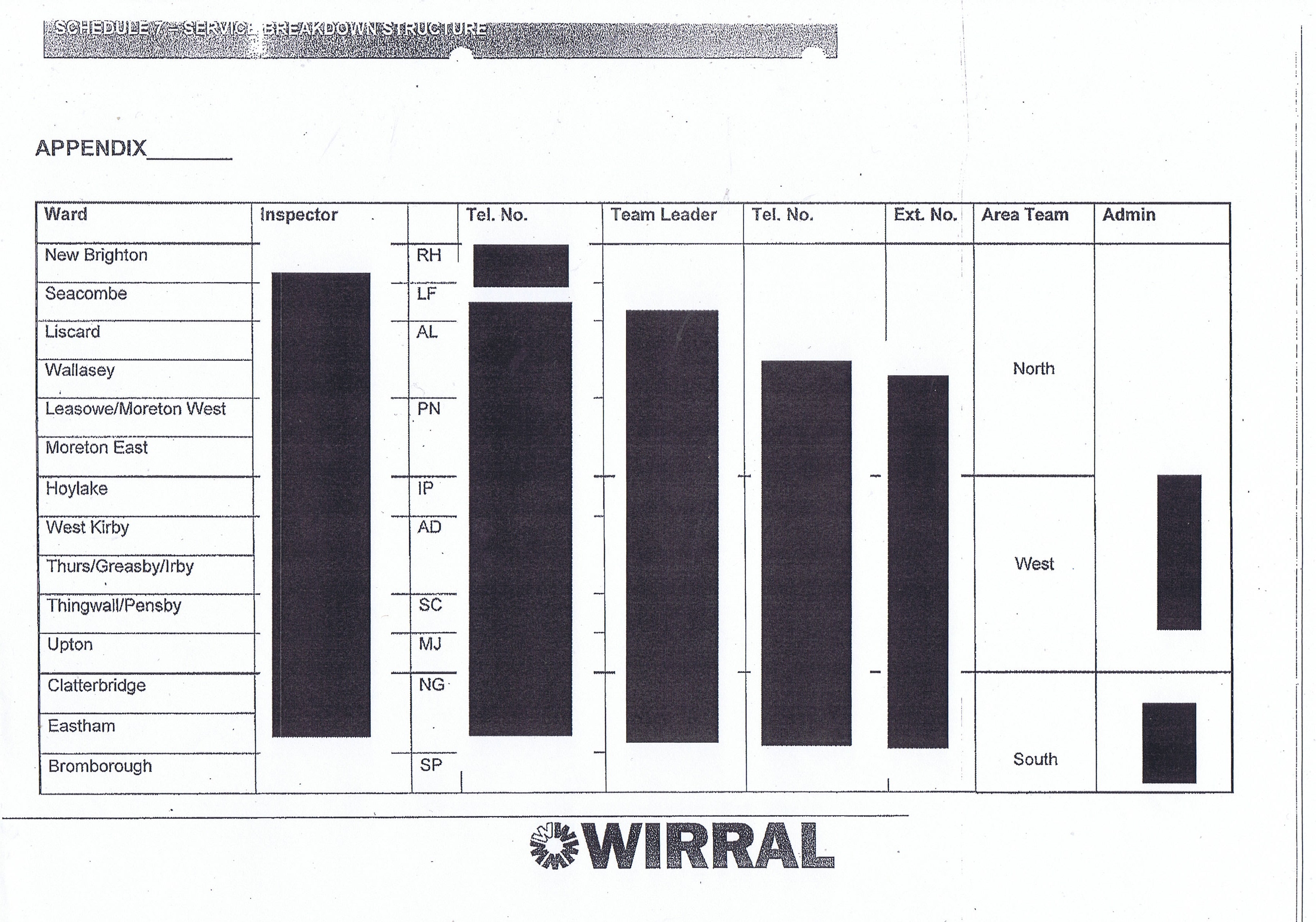
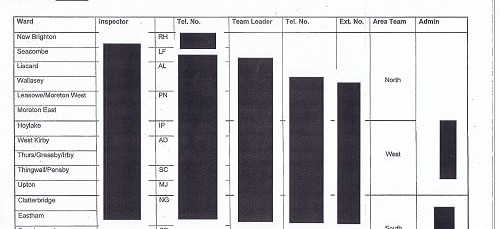
I provide below four pages from what Wirral Council supplied when I requested the Highway Services Contract that Wirral Council have with Bam Nuttall on which millions of pounds are spent each year.

These first two pages (according to the preceding page) are to do with the NRSWA Team (whatever that stands for). This team is described as “a separate team of 4 inspectors monitoring utility works and repeat defects. This team could integrate with the highway teams

As usual the thumbnails link to higher resolution versions of the same image.

Bam Nuttall contract Service Breakdown Structure page 1 of 2 thumbnail
Bam Nuttall contract Service Breakdown Structure page 2 of 2 thumbnail

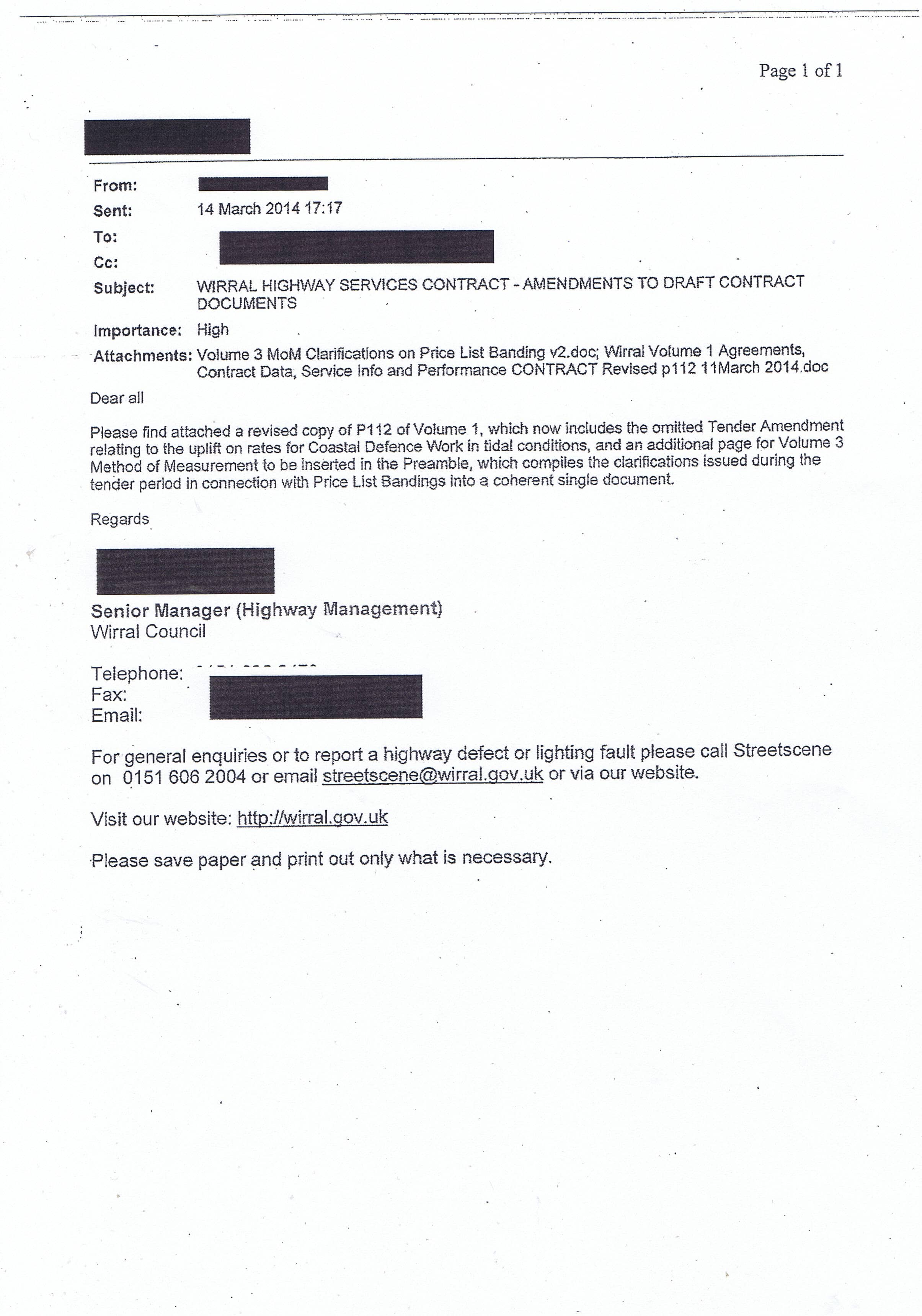
Next is an email detailing some last minutes changes to the contract. The unnamed author of this email receives this blog’s first ever Sir Humphrey Appleby award for the sentence “Please find attached a revised copy of P112 of Volume 1, which now includes the omitted Tender Amendment relating to the uplift on rates for Coastal Defence Work in tidal conditions, and an additional page for Volume 3 Method of Measurement to be inserted in the Preamble, which compiles the clarifications issued during the tender period in connection with Price List Bandings into a coherent single document.

Bam Nuttall contract email thumbnail

Finally, even the author of the Scottish Power Energy Network’s guide to connecting street lights to the mains electricity gets the black box treatment.

Bam Nuttall contract SP Energy Networks Connection Registration and Management thumbnail

If you click on any of these buttons below, you’ll be doing me a favour by sharing this article with other people. Thanks:
Deputy Chief Fire Officer Phil Garrigan tells councillors “90 working days” are lost each year in responding to FOI requests

Deputy Chief Fire Officer Phil Garrigan tells councillors “90 working days” are lost each year in responding to FOI requests


Please accept YouTube cookies to play this video. By accepting you will be accessing content from YouTube, a service provided by an external third party.

YouTube privacy policy

If you accept this notice, your choice will be saved and the page will refresh.

Councillors on the Performance and Scrutiny Committee (Merseyside Fire and Rescue Authority) discuss Freedom of Information requests (starts at 15m 35s) (12th January 2016)

Phil Garrigan (Deputy Chief Fire Officer) speaks about freedom of information requests to a meeting of Merseyside Fire and Rescue Authority's Performance and Scrutiny Committee (12th January 2015)
Phil Garrigan (Deputy Chief Fire Officer) speaks about freedom of information requests to a meeting of Merseyside Fire and Rescue Authority’s Performance and Scrutiny Committee (12th January 2015)

Although I am not referred to by name (but my profession is in the report), I have made Freedom of Information requests to Merseyside Fire and Rescue Service/Merseyside Fire and Rescue Authority during the period covered by that report. An appeal of a refusal of one of those Freedom of Information requests to the Information Commissioner’s Office is referred to in the report in section 16. I am therefore declaring this as an interest at the start of this piece.

I have previously written about Merseyside Fire and Rescue Authority’s response to the consultation on changes to Freedom of Information legislation.

Yesterday councillors on Merseyside Fire and Rescue Authority’s Performance and Scrutiny Committee discussed a report on Freedom of Information requests.

The report was introduced by Deputy Chief Fire Officer Phil Garrigan, who said “Thanks Chair, again this report relates to our response to a request from Members to better understand the implications of the Freedom of Information requests on the Authority and the report proposes to, it requests that Members review the information in relation to Freedom of Information requests and particularly the Freedom of Information Act 2000.

What I would say from the outset is that Merseyside Fire and Rescue Authority adheres to and is supportive of the Freedom of Information Act and values its role in allowing people to access information, giving them the right to find out about matters and decisions that affect them. I’d like to be absolutely crystal clear around that.

However, use of the Act is becoming increasingly popular and the volumes of freedom of information requests have increased over the recent years. The table on page 58 exemplifies that. We received, we saw freedom of information requests in 2011 at 72, 2014 at 138 and up until November 9th 2015 at 131.

So it’s clear evidence that the freedom of information requests coming through to Merseyside Fire and Rescue Authority has increased significantly over that period and you know Members will also be aware that we’ve been receiving those freedom of information requests it’s a requirement on us to turn around that information within twenty days unless we are able to provide you know a legitimate reason as to why we wouldn’t provide that information and even then we’d have to evidence that and reply to the particular individual who’s requested the information.

What we also recognise is that there are different courses of action that we could take. You know a) providing the information, redacting the information, refusing to supply the information by applying an exemption or determining that the work required to pull the information together is disproportionate and then notifying the application that it’s available by other means or by determining the request is vexatious and certainly the Information Commissioner has said you know when challenged around freedom of information and the number of requests it is always available for an authority or an organisation to reject it on the basis that it’s a vexatious request, but equally Members will appreciate the fact that that is quite challenging in that regard because it seems very protectionist, it seems as though we would be withholding information from a public member or an organisation on that basis and it’s very difficult to legitimise that in my view and more often than not the individuals, the staff who are seeking to provide that information will go way beyond what’s expected to provide that information as accurately as they are able to.

But it does place demands on our organisation, particularly as our organisation continues to reduce in size and when we look at the, our attempts to protect our front line operational response and we look at, it’s incumbent on us that we look at the support services that maintain the Service outside of our operational firefighters. So our non uniformed colleagues and uniformed colleagues are spending a significant amount of time dealing with freedom of information requests. So the organisation is shrinking but the demand around freedom of information is increasing.

So what the report does is it recognises that fact, it appreciates the fact that you know we will get a multitude of different requests in, some from you know members of the public, but some extended to journalists and so on and so forth and representative bodies who are utilising the information not in my view for how it was necessarily meant to be utilised in the first instance and also we have requests coming from organisations and companies where they are seeking to achieve you know some competitive advantage and I’m not sure again that was the basis of what the Freedom of Information Act was all about, but drawing all that in then and you know certainly it’s already been recognised as there’s been an independent Commission that has been invoked to review the Freedom of Information Act and we have provided a response to that saying that we are certainly for legitimate and less vexatious requests and maybe a levy or a charge may be applicable to kind of ensure that they are genuine and not repeated and that would maybe prevent some of the prolific you know press requirements being met when such a charge is applicable.

However the Information Commissioner has published a response in relation to that consultation which says, which argues against the introduction of fees and as I say you know starts to suggest that authorities should use section 14 which is around vexatious requests to avoid responding to the ones that were deemed to be you know vexatious in their very nature.

However you know in regards to that as I’ve previously stated, paragraph 12 describes the challenges around describing something as vexatious and that’s not something we would want to be perceived to be defensive over the policies and procedures that we’ve adopted as an Authority. I’m not sure we would want to be, or I certainly know we would want to be as transparent and open as possible but nevertheless what does that mean in reality?

In reality it means that since July 2015 through November, 32 complete requests have been responded to and the total of hours that have been attributed to that to deal with those requests 153 hours, which equates to 4.8 hours per a request for information. When you extrapolate that over the twelve month period it equates to 629 hours which again would be in effect is about 90 days of a person who is being responded to and obviously that’s a collective person because that’s an hour of one department, two hours of another, three hours of another and so on and so forth, but in totality it’s about 90 working days that’s lost from this Authority in responding to freedom of information requests at a time when we would be better focussed on our attentions on the delivery of the service and as I say protecting the front line.

However that is the kind of realities and again this is not about us, you know, challenging the utilisation of freedom of information but certainly it questions its actual usage in its broader sense and who actually uses it for what reasons.

When you then as part and parcel of our response to the consultation we asked staff members about what they felt the implications were for themselves and they are detailed in paragraph 19.

But what I would say in kind of closing and given that the kind of clarity of 90 working days lost to responding to freedom of information requests, I’ll just bring you back to the legal implications. Merseyside Fire and Rescue Authority has a duty under the Freedom of Information Act to deal with requests promptly and in the event no later than 20 working days after receipt of the requests.

Merseyside Fire and Rescue Authority can exercise its rights under the Act if an exemption has been correctly applied and in most cases the public interest test is then applied to ensure any exemptions are correctly applied under those circumstances.

So there are ways in which we can deal with them, but again just to reiterate the point, our intent is to be as open and transparent as possible. We are you know responding to each and every one and it does incur a significant cost associated with them of 90 days across the whole 12 months of the organisation irrespective of who necessarily deals with them but certainly there are members of certain teams who spend an inordinate amount of time dealing with requests. I’m happy to take any questions on that Chair.”

If you click on any of these buttons below, you’ll be doing me a favour by sharing this article with other people. Thanks: