“Malicious editing” & “inaccurate, offensive or biased” in responses to new public meetings filming law
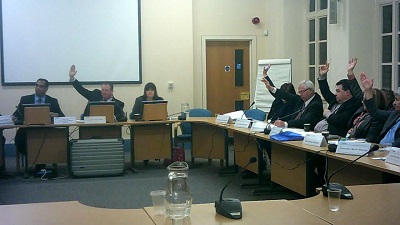
Labour councillors at a public meeting of Wirral Council’s Coordinating Committee vote to consult on closing Lyndale School (27th February 2014) (an example of the sort of public meeting covered by the new regulations)
Last week I detailed some of the responses to a consultation by the Department for Communities and Local Government on the Openness of Local Government Bodies Regulations 2014 (the law preventing local government bodies from stopping filming of their public meetings). There were a number of responses I didn’t mention which are summarised below (along with some comments of my own). For the whole response from each body you can follow the link to the Department of Communities and Local Government’s response to my Freedom of Information Act request on the whatdotheyknow.com website.
Association of Democratic Services Officers
The Association of Democratic Services Officers (ADSO) is a professional body that represents staff working in democratic services in local authorities covering staff that do councillor support and support the running of local authority committees. ADSO wrote that “In general ADSO welcomes the draft regulations which we feel are a positive step towards the openness and transparency of local authority meetings” and then went on to raise the following interesting question and point.
“1. The regulations contain provisions relating to providing reasonable facilities for recording decisions/proceedings – we understand that the Secretary of State has the power to direct what “reasonable facilities” means and it would be helpful to know if this is likely to happen – for instance will local authorities be expected to provide internet facilities for attendees?
2. There might be difficulties in establishing a common set of requirements – not to mention the cost and security implications if authorities are told they have to provide free public WiFi in meeting rooms and they do not already have the infrastructure in place.”
Wirral Council does already have wireless internet access at Wallasey Town Hall (which is where most of their meetings are held). However these are for use by councillors and officers, are password protected and members of the media would need to know the password in order to use them (or the requirement to enter a password would have to be removed from one of the wireless networks by a settings change).
If the password to this network was made available to the media it could be used for live broadcasting of meetings as they were filmed rather than the way I do it at the moment which is to compress the video clips overnight and upload them the next day. For those providing a live Twitter feed of public meetings on a mobile phone, I would guess that using a wireless network instead of sending it over a mobile phone provider’s network would use less battery. At least one journalist brings multiple mobile phones to Council meetings that last for hours to write on Twitter about the meeting. Using a wireless network would be less expensive on data charges. It will be interesting to know how “reasonable facilities” is interpreted.
Bracknell Forest Borough Council
The Borough Solicitor of Bracknell Forest Borough Council only wrote this about the filming issue “2. There should be provision in the regulations to allow Councils to establish procedures to ensure that the right to record or film meetings should not be exercised in such a way as to disrupt the conduct of the meeting.”
Devon and Somerset Fire and Rescue Authority
The clerk to the Devon and Somerset Fire and Rescue Authority wrote a three page response (also copied to Carolyn Downs of the Local Government Association). The response stated that the issue had been discussed at the Devon and Somerset Fire and Rescue Authority meeting of the 24th February 2012. Devon and Somerset Fire and Rescue Authority had what could be described as a lukewarm response with the clerk writing things like “While as a general principle the move towards greater transparency is to be welcomed, it is suggested that this needs to be tempered with what is reasonable and practicable”.
Devon and Somerset Fire and Rescue Authority referred to a hypothetical future public meeting “whereby a particular decision to be taken could generate significant media and public interest”. They went on to state “While endeavours might be taken to accommodate this as far as possible, there could come a point whereby it might not be possible to accommodate all who might wish to attend.”
Their point was that the existing legislation stated that public meetings “shall be open to the public” whereas the regulations modified that to “grant a carte blanche permission for any and all persons to attend meetings” which meant that whereas the existing legislation meant they felt that they could turn people away from public meetings on grounds of capacity or fire safety, once it was modified they didn’t feel they would be able to do this. As with many responses to the consultation they were against the idea of a right to live commentary as this would be “somewhat disruptive and not conducive to concentration or effective decision making”. This was also stated in their response “There is also a risk of inaccurate or misleading reporting taking place if commentary (orally or in writing) in made before the debate is concluded and any final decision made or vote taken.
Essex County Fire and Rescue Service
Essex County Fire and Rescue Service’s Head of Law and Corporate Administration responded to state “in my view that, save for the use of recording equipment in public meetings, the governance of decisions in the Essex Fire Authority and indeed its subordinated Service is carried out in a way not dissimilar to the provisions of the draft regulations and appears to be very open and transparent for the public to secure clear insight into the use and discharge of EFA powers.”
Greater London Authority
The Greater London Authority (GLA) and Greater London Authority Group were supportive of the principles behind the regulations and stated “At the outset, we wish to express our general support for the principles which the Draft Regulations seek to implement. The GLA has done a great deal to improve its transparency and public access to decision-making, of our own volition and in support of the Government’s wide transparency agenda for local government bodies. We recognise the benefits that this brings to our customers and stakeholders but also to ourselves.”
Hampshire Fire and Rescue Authority
The Chairman of Hampshire Fire and Rescue Authority responded by stating that Hampshire Fire and Rescue Authority “welcomes the opportunity for greater transparency and openness to local governance body meetings by allowing any persons to attend the meeting for the purposes of reporting.” and “A positive impact of the draft Regulations would be that members of the public would become better informed on the business of HFRA and as a result, the business of HFRA would be promoted to a wider audience.”
However their response wasn’t all positive as the Chairman also went on to state, “However, it is possible that persons may attempt or distort or edit the broadcast in some way to create a misleading impression.” and “HFRA considers the draft Regulations do not make any reference to ‘disturbances’ that could be caused at meetings by persons reporting and the impact that the disturbance could have on the meeting. HFRA recommends the ‘Plain English Guide’ to include guidance on disturbances and to the removal of a person from a meeting if their reporting renders the proceedings at the meeting impossible.”
Kent Fire and Rescue Service
The Chief Executive of Kent Fire and Rescue Service, Ann Millington gave the following response to the filming and social media issue:
“The Authority is committed to openness and transparency and has already drafted a policy on filming and the use of social media at its meetings. The Authority therefore has no objection in principle to giving the public a legal right to film or use social media for reporting on local authority meetings. However, the Authority does have serious concerns about some of the more detailed proposals contained in the draft regulations.
First, the Authority would question the need for the proposed amendment to section 100A(6)(c) of the Local Government Act 1972 requiring local authorities to provide “reasonable facilities” for members of the public to report meetings. This amendment is unnecessary given that the proposed new subsection 7A gives members of the public the right to attend meetings for the purposes of reporting. It is undesirable because it would put members of the public who wish to report on a meeting (or who just claim that they wish to do so) on a par with professional journalists representing newspapers. It is wrong to equate ‘citizen reporters’ with professional journalists because the latter are (as the Act itself says) “duly accredited” and work to professional standards. Local authorities have a reasonable expectation that professional journalists will report local authority meetings accurately and objectively. If these expectations are not met, then there are clear procedures by which local authorities (and others) can complain and have inaccuracies corrected. In contrast ‘citizen reporters’ can be as inaccurate, offensive or biased as they wish, and it is very difficult for local authorities to counter this.
In practice, the only ‘reasonable facilities’ that local authorities provide for professional journalists is reserved seating. There is a danger that giving ‘citizen journalists’ the same rights to ‘reasonable facilities’ as professional journalists would result in members of the public wishing to report on meetings, or claiming they wish to do so, demanding priority for the available seating over other members of the public. This could be very unfair where a meeting generates so much local interest that not all the members of the public wishing to attend can be accommodated.
The Authority’s second concern is that the draft regulations appear to give members of the public wishing to report on local authority meetings an absolute right to do so. However the regulations need to incorporate a provision that the public’s right to report is subject to any reasonable conditions which the local authority may feel appropriate. These conditions may include a requirement to advise the Chairman of the meeting before the meeting starts of any intention to film or record (so that the Chairman can advise all attendees, including other members of the public, of this) as well as a prohibition on covert filming or recording; and a requirement not to cause any disruption to the meeting. Although subsection (8) already covers ‘disorderly conduct or other misbehaviour’, it does not cover the sort of disruption that would be caused if a member of the public exercising their right to film (under subsection (10)(a)) chose to wander around the meeting room while doing so, or if a member of the public exercising their right to provide commentary on proceedings of a meeting orally (under subsection (10)(c)) did so loudly enough to interfere with the formal debate.”
Lawyers in Local Government (LLG)
Lawyers in Local Government (LLG) responded as follows on the filming issue, “There is a strong view that there needs to be a power for Council to allow subject to limits on what can be filmed – e.g. speaker notes, listeners notes, etc.? What about the recording of members not participating in the debate? Should there be a sanction for concealment? (There is a cadre of opinion that the Chair of a meeting should have the power to prevent councillors from tweeting/blogging during meetings as some chairs take the view that this is at best not participating as they should and at worst disrespectful to the meeting.)
Has there been consultation with NALC? The extension of the provisions to all parish council’s and parish meetings seems to be ‘over the top’ – perhaps it should be linked to the criteria for Quality Council status, the majority of parish councils (and effectively all parish meetings) simply not being resourced for the additional administration?
What is the Department’s view on what a Council could do if a recording were made and then published, particularly in an edited format which misrepresented what had actually happened at the meeting?”
Nottinghamshire County Council
The Corporate Director for Policy Planning and Corporate Services at Nottinghamshire County Council had this to write about the filming issue, “The County Council supports public access to meetings, and the right of the press and public to report and record them. However, the legislation should take account of practical implications; recording should not disrupt the smooth running of meetings, and authorities should be able to request reasonable notice, limit numbers and so on where appropriate.”
National Association of Local Councils
NALC (the National Association of Local Councils) represents around 9,000 parish councils in England. On the filming issue their policy and improvement officer wrote the following, “While NALC supports the objective of transparent and accountable local government, we are deeply concerned some key sections of the draft regulations will have a significant effect on the operation of parish councils, leading to an increase in red tape and bureaucracy and adding unnecessary new costs.”
NALC’s comments and recommendations on the filming issue were:
“
- any person seeking to film or record a meeting of a local council be required to announce their intention to the council or council staff prior to the commencement of the meeting;
- in the interests of openness and transparency, the names of any person(s) seeking to film or record a meeting of a council required to be recorded in the minutes of the meeting in question;
- regulations should reflect the need for permission to be sought from members of the public to be filmed or recorded during the public participation element of the meeting;
- where filming or recording does take place, any running verbal commentary by a person(s) should not disrupt the meeting, with the Chairman of the meeting able to ask the person(s) to stop any verbal commentary on the grounds of disruption, should disruption continue as a last resort be able to ask them to leave the meeting;
”
NALC consulted with their member councils and highlighted these issues from the responses that they received:
“The majority of our councils are extremely concerned that the regulations which seek to amend the Public Bodies (Admission to Meetings) Act 1960 to allow a member of the public to film or record public meetings could be used to provide biased or inaccurate coverage of those meetings, to the detriment of the council or individual councillors.”
“Councils clearly feel that the intention of the filming and recording regulations in particular would have a different effect on the local (parish and town) council tier rather than on the larger, and better resourced, local authorities.”
“Clear guidance, drafted specifically for the local council sector, could alleviate many councils’ fears, particularly in relation to the expected resourcing of regulations relating to reporting delegated decisions and filming, as well as clearly articulating sector expectations.”
NALC’s comments and concerns on the proposed regulations were set out in more detail in various sections (which you can read below).
“Regulations requiring parish and town councils to allow any persons including professional journalists to attend, film, audio record, take photographs or provide commentary on the proceedings at public meetings
As noted above, this proposed regulation drew the most comment from our sector.
Generally, parish councils are supportive of the Government’s intention and policy objective, but remain concerned that vexatious recordings could be made that create an inaccurate impression of council decision making and which are distributed to a large public audience.
It was for this reason that a significant proportion of our councils are against the implementation of this regulation. Further detail is provided below.
- Councils making their own recordings
Many councils have expressed a view this regulation would require them to record and upload their own web recordings, in order to ensure a true record of proceedings was maintained in video format (in addition to the minutes of the meeting). It was felt that this would be necessary to protect against any modified film or video recordings that could give a public misrepresentation of proceedings. Smaller councils in particular were concerned that they do not have the resources to make their own recordings with which to protect themselves from the consequences of this regulation. For example, Didcot Town Council (although a large local council) outlined the resources required:
‘[Council’s] would need to provide audio-visual recording equipment in their meeting rooms to provide a corporate record of all meetings and this would need to be staffed and archived…. Media and legal training would need to be provided to councillors and staff which would take time and finance.’
As the tier of Government closest to the community they represent, a number of parish councillors felt intimidated by the thought of being filmed and/or recorded in their capacity as councillors. They argued that the idea of being filmed surreptitiously was a significant deterrent to current and even potential parish councillors, thus serving to weaken rather than strengthen democracy. Great Baddow Parish Council wrote:
‘Finally, as we know, it is difficult enough already to get people to stand as parish councillors. It seems to be forgotten that they are unpaid public officials, volunteering their time, providing a community service. … Having what they say in council meetings … broadcast around the village, if not the world and possibly held to ridicule by the Daily Mail is not calculated to increase the number of people willing to become councillors. Or perhaps the younger generation, brought up on Facebook, will not care?’
- Filming members of the public
The sector also expressed concern that members of the public might be deterred from participating in open discussion on contentious issues if they were aware they were being filmed. The Oxfordshire Association of Local Councils provided an example of the concern they heard from their members:
‘We accept constructive and responsible use of all forms of technology – blogging, tweeting, filming and recording. However, we recognise that some councils feel that allowing filming, in particular, could be intrusive and inhibit free speech, deterring people from speaking out on contentious issues such as planning applications. This is very relevant in small communities where members of the public, as well as councillors, may feel intimidated from expressing their views. It is accepted that councillors by standing for election to public office have, by default, acknowledged some degree of exposure but members of the public need some measure of reassurance that their views will not be misrepresented by malicious editing.’
- Announcement of intention to film or record
In order to address this concern, a significant number of councils proposed that people intending to film or record a public council meeting make their intention known to council staff, who could then inform councillors and members of the public attending the meeting. It was felt that this would go some way to ensuring that the recording was not used maliciously and that it would not be disruptive to the conduct of council business. Some councils suggested that prior written consent should be obtained before filming or recording could take place.
The National Association, on behalf of our members, supports this amendment. We would like to see the regulation amended to require that any person seeking to film or record a meeting of a local council announce that intention to the council or council staff prior to the commencement of the meeting and have this intention recorded in the minutes of the meeting. This would allow councillors to raise this intention with any participating members of the public that are present and assuage ongoing concern around filming with malicious intent, without inhibiting the desire for transparent and participative local governance.
In addition, we recommend that the regulations should require permission from members of the public to be filmed or recorded be sought prior to the commencement of filming.”
If you click on any of the buttons below, you’ll be doing me a favour by sharing this article with other people.